I seriously do not know how I went twenty-four years of my life without this fruit. I discovered it last fall - they're called kakis here, persimmons in English - and I think I practically lived off it for three or four months. Then I spent about nine months eagerly awaiting the start of 2012 persimmon season.
Why so special, you ask? They're sweet, crunchy, have a fantastic, thick, pretty orange skin (I know, I'm weird, I always eat my fruit with the skin on, no matter how tough it is...unless it's like, an orange). Perfect for autumn. And, if you cut them horizontally there's a star in the middle, a bit like when you cut an apply horizontally.
Word of advice, though: there are two main varieties of persimmons, the gross variety (in my opinion), which is shorter and rounder and you have to let ripen until it's really soft and then you scoop it out; and the good version, which is slightly more elongated and eaten while it's firm. Mmm, I love crunchy fruit!
Edit: After some disconcerting research, I discovered that you shouldn't eat persimmons too often, and you shouldn't eat them on an empty stomach, especially with the skin on (i.e. basically the only way I eat them). Apparently they contain "a compound called shibuol" that doesn't react well with stomach acid and could eventually lead to digestive issues. I have no idea how much of a risk this is or if it applies to all different types of persimmons but...maybe just to be safe I'm going to stop eating them for breakfast every single day.
viernes, 19 de octubre de 2012
jueves, 4 de octubre de 2012
Made in the USA...Sold in España
Remember I wrote this post about American things (or things found in the US) that I miss because you can't find them in Spain? (Part Two is coming, hopefully soon, by the way.)
Well, here's a brief update on American products of a different category: things that you actually can find here in Spain and that I miss enough to pay ridiculously exorbitant prices for every once in a while.
1. Canned pumpkin. Maybe fresh pumpkin is better (I don't know, I'm too lazy to have ever tried cooking with it), but even fresh pumpkins aren't very popular here. But to me, autumn = pumpkins. Among other things. But especially pumpkins. Not to mention Thanksgiving just isn't Thanksgiving without a pumpkin pie. So finding canned pumpkin is a once or twice a year necessity. I'm not sure if there are any Spanish grocery stores that sell canned pumpkin, but I've never seen it. If anyone ever has, please let me know! But anyway, I've always gone to Taste of America, where it costs €3 a can. Not terrible, but more expensive than I've ever seen at home. I recently bought a couple of cans to make pumpkin bread with, and it was totally worth it.

3. Peanut butter. The funny thing is, I'm not really even much of a peanut butter fan. I love love love peanut butter cups or any other form of chocolate and peanut butter together, and I love it with apples, but I never eat peanut butter and jelly sandwiches, for example. I think it's the texture - it's just way too much between the stickiness/thickness of the PB and the bread. Anyway, I remember when I studied abroad here I brought a jar of PB, knowing that it was hard to find, and I went through that thing with lightning speed. I don't buy it often now, but I've found it in a couple of grocery stores and I therefore don't bother bringing it from the US. The latest regular-sized jar I bought cost me €4,50...which I do think is a lot for peanut butter...
So there you have it: these are the products that I occasionally like to pick up, mostly at Taste of America. (Notice how it's all food?) It's a cool little store (right by the NYU campus here), and they carry both food products and even American-style cookware, such as cupcake pans, cake decorating items, etc. They even have some weird products that I've never seen before (mostly brands, not actual foods), which is a funny, but seeing as America is pretty big, I guess I'm bound to not know ever brand ever in existence. Also, several times that I've bought stuff at Taste of America, they've given me random things free with my purchases - like this bag of Goldfish in the picture above. I don't even buy Goldfish often in the US, so I really can't remember the last time I've had them, but it was a nice little culinary reminder of home.
Well, here's a brief update on American products of a different category: things that you actually can find here in Spain and that I miss enough to pay ridiculously exorbitant prices for every once in a while.
![]() |
| The cake mixes are perhaps the most overpriced - €6 or €7 a box! |
2. Brown sugar. The concept of brown sugar just doesn't exist here. They've got "azúcar moreno," which sort of is brown sugar (and is what that translates to), but in reality, it's only what we call raw sugar. Not the same as our probably extra-diabetes-enducing molasses-sugar mixture. Obviously this isn't something I use all that frequently, but I do like it on oatmeal and making certain baked goods, such as the good old chocolate chip cookie, is impossible without it. I also buy this at Taste of America - where it's generally about €1,50 - because I've never seen it in regular grocery stores either.
3. Peanut butter. The funny thing is, I'm not really even much of a peanut butter fan. I love love love peanut butter cups or any other form of chocolate and peanut butter together, and I love it with apples, but I never eat peanut butter and jelly sandwiches, for example. I think it's the texture - it's just way too much between the stickiness/thickness of the PB and the bread. Anyway, I remember when I studied abroad here I brought a jar of PB, knowing that it was hard to find, and I went through that thing with lightning speed. I don't buy it often now, but I've found it in a couple of grocery stores and I therefore don't bother bringing it from the US. The latest regular-sized jar I bought cost me €4,50...which I do think is a lot for peanut butter...
Baking soda is also sort of a weird situation here - they sell what I think is the chemical equivalent here in grocery stores, but I think it's used more for cleaning than for baking. Normally it's only baking powder here. I've never tried this supermarket equivalent because I bought a box of way overpriced Arm & Hammer at Taste of America a couple of years ago and obviously I haven't even gone through a quarter of the box. I'm more likely to have to get new baking soda because this box is going to expire, rather than actually run out.
![]() |
| Sesame, onion, and plain bagels! |
One last thing that is hard to find here in Spain, and when you do find
it, it's usually not that great, is bagels. They actually sell them at
Taste of America and also some specialty bakeries, but I've found it's much more cost effective (and
let's face it, much more FUN) to make my own bagels. Mmmm.
So there you have it: these are the products that I occasionally like to pick up, mostly at Taste of America. (Notice how it's all food?) It's a cool little store (right by the NYU campus here), and they carry both food products and even American-style cookware, such as cupcake pans, cake decorating items, etc. They even have some weird products that I've never seen before (mostly brands, not actual foods), which is a funny, but seeing as America is pretty big, I guess I'm bound to not know ever brand ever in existence. Also, several times that I've bought stuff at Taste of America, they've given me random things free with my purchases - like this bag of Goldfish in the picture above. I don't even buy Goldfish often in the US, so I really can't remember the last time I've had them, but it was a nice little culinary reminder of home.jueves, 27 de septiembre de 2012
Polska
I've gotten the question several times, "why Poland?"
The honest answer was a combination of: I wanted to go somewhere I knew
little about, somewhere different from western Europe, somewhere not
too touristy, and somewhere that I wasn't sure would be a safe place to
travel on my own (it is completely safe, by the way, I've just read to
avoid night trains).
Poland
was the first surprisingly excellent choice I made for travel this
summer (the other being my first-ever solo trip to Sweden, Estonia, and
Cataluña in northern Spain, but more on that in another post). I had
relatively high expectations for Poland, and
they were more than exceeded, in Krakow in particular. The whole
country, from the Tatra mountains at the southern border with Slovakia to
Warsaw (I really still can't believe that this city was more than 85% destroyed during
WWII and managed to rebuild and bounce back in a matter of only about 20 years - incredible) to the Baltic coast, is all really beautiful. And,
like Hungary, everything is really cheap and the cuisine is awesome
(provided that you like potatoes, cabbage, sausage, and dumplings, to
all of which I say, keep it comin').
| Morskie Oko, the largest glacial lake in the Tatra mountains. |
| Sunset in Torun. |
| PIEROGIS! |
So anyway,
this blog is really more supposed to be about Spain and the joys of
living here, so I'll keep the non-Spanish stuff to as much of a minimum
as I'm capable. I'll leave you with two things:
1. in Poland we went to the cities/towns of Krakow, Zakopane (in the Tatras mountains), Warsaw, Torun, Malbork, Gdansk, and Poznan,
2. and a piece of advice - if you have the chance to travel to Poland, do it. It's so underrated and so worth the visit.
martes, 4 de septiembre de 2012
Hiking in the Community of Madrid
If you've ever been to Madrid and done day trips in its alrededores, such as Toledo, Segovia, Alcala de Henares, etc., you probably leave the city via Barajas airport surprised at the fact that, well, you can see mountains in the distance. Believe it or not, Madrid actually has quite a large area of mountains (mostly to the north) with a great deal of hiking and even some skiing in the winter. Madrid itself is actually the highest European capital at some 2100+ ft (650 meters). (Apparently Andorra's capital is actually higher but Andorra only sort of counts as a country so I'm just going to give this one to Spain because aside from football, they don't have a lot going for them at the moment.) We have a weird climate here - pretty cold in the winter (because of the altitude), though not nearly as cold as the New England winters I grew up with (in the city of Madrid it rarely snows), and pretty hot in the summer, with mid June to the end of August in the 90s(F) and often days that get above 100F. The air is very dry and therefore it mostly only rains for a couple weeks in the fall and the spring and rarely ever in the summer. Not going to lie - the weather here is pretty fantastic.
But anyway, back to the mountains. I really never knew much about Madrid's surroundings for too long of a time. I vaguely knew somewhere in the back of my mind that there are mountains in the north (maybe from my mild obsession with maps, the Google variety in particular), but I never took that thought seriously. Like I said, if you go outside Madrid - of even if you're in Madrid - you'll notice that because it's so dry, vegetation is scarce. Highways leading out of Madrid literally pass through flat, dusty, bare fields. Even the mountains themselves aren't very green from a distance (and in actuality, some aren't).
My point is, I never thought Madrid would have good hiking.
Wrong. Madrid has some great hiking with some beautiful views and great trails. It took me a while to discover this, but I found out in a great way. Last fall, a friend of mine was Googling hiking in the Madrid area and came across a group that does hiking excursions on the weekends in the fall and the spring. At this point it was November, so the season was over (the mountains actually do get snow and ice in the winter), but we decided to check out the group when the spring season started up.
Basically, a few years ago, two Americans living here started the group and over time it grew. They also wrote a book about many of the hiking routes in Madrid (both north and south of the
city, actually), because they discovered that there weren't any books on this topic published in English. Unfortunately, they're both back in the US now, but the group has been passed on to new hands (we went on the first hikes for the "fall" this past weekend!) and it's really a blast. Not only was I proven oh-so-wrong about there being no nature in this barren land, but each time I've gone on hikes I've met new people from various places - some Spaniards, some Americans, other foreigners living in Madrid, tourists in Madrid that are just there for a few days, etc. Some people you see once and some people go regularly and you get to know them. It's a great social experience - not only does it get you out of the pollution-filled city into some fresh air, but you meet new people and often times it's a great intercambio opportunity (the hikes are led in English but often you find yourself talking to someone in Spanish).
The hikes really vary a lot in scenery - sometimes you're walking in a forest, sometimes you're practically rock climbing, sometimes there are caves, sometimes there are animals (both wild and domesticated). Sometimes the routes start or end (or both!) in cute little Spanish towns that you may otherwise never know to visit (such as Patones de Arriba). Sometimes they start or end in well-known towns that already attract lots of tourists (such El Escorial and Chinchon). Sometimes it rains, sometimes it snows (once, honestly!), sometimes its 90 degrees out in the blazing sun...but I've always had a good time (cheesy or not).
And we always end the hikes with a nice cold one of these:
On some rare occasions we're able to end a hike like this:
So if you live in Madrid, you should check out the group. If you're just visiting Madrid, you should still check it out!
![]() |
| See? Told ya there are mountains. This is by Puerto de Navacerrada. |
![]() |
| Mountains overlooking the town of El Escorial (see the monastery?) |
![]() |
| View from "la Maliciosa" (literally, the "malicious" mountain - it's a toughie). |
![]() |
| Green. (Patones de Arriba) |
| Um...not green. (La Pedriza at the end of the summer.) |
My point is, I never thought Madrid would have good hiking.
Wrong. Madrid has some great hiking with some beautiful views and great trails. It took me a while to discover this, but I found out in a great way. Last fall, a friend of mine was Googling hiking in the Madrid area and came across a group that does hiking excursions on the weekends in the fall and the spring. At this point it was November, so the season was over (the mountains actually do get snow and ice in the winter), but we decided to check out the group when the spring season started up.
![]() |
| Check out this view! (Patones de Arriba/Cancho de Cabeza) |
![]() |
| Lots of pretty mountain flowers. |
![]() |
| Animal life - mountain goats of some sort. |
![]() |
| LOTS of cows also. |
And we always end the hikes with a nice cold one of these:
On some rare occasions we're able to end a hike like this:
![]() |
| Dipping our feet in the water near Rascafria on a hot June day. |
jueves, 30 de agosto de 2012
Teaching Eeengleesh in Espain
I thought that since it's nearly September (seriously, HOW did that happen?), it was about time that I finally actually admit to the fact that, well, I'm living in Spain to teach English, not to go gallivanting off to as many foreign countries as possible. As you may or may not know, this past year I somehow got myself into teaching English to (mostly) preschoolers. I had seven classes in the primary school (fourth, fifth, and sixth graders), but the majority of my 25 hours teaching were spent with 3-, 4-, and 5-year-olds. Don't ask me how or why that happened. (Not because there isn't a why or a how, but rather because it's better that I leave that topic alone.) So anyway, I spent the greater portion of the last ten months reviewing colors and numbers, playing games, and teaching songs. (That's right, my friends, I was forced to break my strict rule of never, ever singing in public - but it's okay because they're so little they don't care, right? Or perhaps the opposite, I'm scarring them for life with my awful singing voice?)
I'm still not sure how, but I somehow grew to enjoy teaching the little kids. After all, they're too young to be really obnoxious or critical or negative like teenagers and preteens can be. This isn't to say that teaching such young children English is a piece of cake, because it isn't; more than anything it's very difficult to keep their attention for nearly an hour in a language that is almost entirely foreign to them when they're that young. Some classes wound up being really great and easy and fun, while a select few others were just short of a nightmare.
Naturally, the five-year-olds were my favorite this past year. They're the oldest (in preschool), they know the most English, and they also just happened to be a really great group of kids. (I know teachers aren't supposed to have favorites, but let's be real - it happens. I absolutely had some favorite students, and the majority of them were five-year-olds.) Unfortunately, it's unlikely I will have these students next year when they more to first grade in primary school. I'll see them but I most likely won't teach their English classes.
I should probably clarify that the majority of my preschoolers still have an...interesting level of English competence. This is something that varies greatly amongst Spanish schools, and as far as I know, the English program at my school is relatively new. The vast majority of the preschoolers I teach have never heard or spoken any words of English when they enter preschool at three years of age, and since they only get an average of five hours of English a week, the learning process is slow. However, I can generally lead my classes in English and speak entirely in English with my preschoolers and they understand the majority of what I say (especially the five-year-olds), but they aren't able to produce full sentences on their own. My four- and five-year-olds know how to say "My name is...", "I like...", and "I'm fine thank you, and you?" but these are automatic phrases they've learned by memorization. By the time they reach third or fourth grade they will most likely have a pretty decent level of English (as far as Spain goes), so they're on the right track.
But the great - and surprising, to me at least - thing about their level of English is that they do understand a great deal of what I say, even if it's just the gist of it and not word for word. Furthermore, they have an incredible vocabulary, the five-year-olds in particular. They know more animals in English than I think I knew in Spanish previous to this year, they can tell you what the weather is like, they know a ridiculous amount of insects in English, they can tell me what foods and sports they like, and most impressive of all, they know the alphabet in English and can identify a lot of words written out in English. It really is incredible how much information their brains soak up.
Anyway, my classses in primary were a much different experience (i.e. they can usually - keyword "usually" - speak full sentences in English and they're often much bigger pains in the butts). I had a little bit of different things, science taught in English (a serious nightmare), English grammar classes (where I was actually for once the teacher's assistant, what I'm actually supposed to be), and English theater workshops (a mix of fun and nightmare). I'll admit that even though the primary classes could be miserable, mainly because of the students' awful behavior, it was generally nice to have a mix of older kids with the little preschoolers.
I'm going to leave commenting on the Spanish education system, the program that I'm a part of in order to teach here, and the differences between education here and in the US until another time...probably once I've finished this school year because, well, I want to keep my job (if you catch my drift). But I will say, it has been a very interesting experience...
Oh, and the above video is the five-year-olds at their preschool graduation, singing a song in English (not taught to them by me). The quality isn't great, and I didn't realize that I was NOT recording the song until halfway through (oops), hence why it just starts in the middle of a line. But I think it's cute and they did a great job singing it - it's a challenging song for their age/English level!
I'm still not sure how, but I somehow grew to enjoy teaching the little kids. After all, they're too young to be really obnoxious or critical or negative like teenagers and preteens can be. This isn't to say that teaching such young children English is a piece of cake, because it isn't; more than anything it's very difficult to keep their attention for nearly an hour in a language that is almost entirely foreign to them when they're that young. Some classes wound up being really great and easy and fun, while a select few others were just short of a nightmare.
Naturally, the five-year-olds were my favorite this past year. They're the oldest (in preschool), they know the most English, and they also just happened to be a really great group of kids. (I know teachers aren't supposed to have favorites, but let's be real - it happens. I absolutely had some favorite students, and the majority of them were five-year-olds.) Unfortunately, it's unlikely I will have these students next year when they more to first grade in primary school. I'll see them but I most likely won't teach their English classes.
| Preschool graduation. |
But the great - and surprising, to me at least - thing about their level of English is that they do understand a great deal of what I say, even if it's just the gist of it and not word for word. Furthermore, they have an incredible vocabulary, the five-year-olds in particular. They know more animals in English than I think I knew in Spanish previous to this year, they can tell you what the weather is like, they know a ridiculous amount of insects in English, they can tell me what foods and sports they like, and most impressive of all, they know the alphabet in English and can identify a lot of words written out in English. It really is incredible how much information their brains soak up.
Anyway, my classses in primary were a much different experience (i.e. they can usually - keyword "usually" - speak full sentences in English and they're often much bigger pains in the butts). I had a little bit of different things, science taught in English (a serious nightmare), English grammar classes (where I was actually for once the teacher's assistant, what I'm actually supposed to be), and English theater workshops (a mix of fun and nightmare). I'll admit that even though the primary classes could be miserable, mainly because of the students' awful behavior, it was generally nice to have a mix of older kids with the little preschoolers.
I'm going to leave commenting on the Spanish education system, the program that I'm a part of in order to teach here, and the differences between education here and in the US until another time...probably once I've finished this school year because, well, I want to keep my job (if you catch my drift). But I will say, it has been a very interesting experience...
Oh, and the above video is the five-year-olds at their preschool graduation, singing a song in English (not taught to them by me). The quality isn't great, and I didn't realize that I was NOT recording the song until halfway through (oops), hence why it just starts in the middle of a line. But I think it's cute and they did a great job singing it - it's a challenging song for their age/English level!
martes, 28 de agosto de 2012
Hungary (and a little bit of Slovakia!)
![]() |
| View of Pest across the Danube from the Fisherman's Bastion in Buda. |
I'm not going to give you a detailed account of what we did during our trip because, well, I think that's pretty boring. And my pictures will give you a better idea of that anyway. What I will tell you is that aside from a few days in Budapest, we also took day (or half-day) trips to the little towns of Visegrad, Szentendre, and also the larger city of Bratislava, the capital of neighboring Slovakia. We loved Budapest and Bratislava. The other Hungarian towns were nice and pretty but nothing too spectacular.
| Bratislava - isn't it pretty?! |
| House of Terror |
So there's my Budapest trip in a nutshell (maybe...I'm not very good at keeping things short). Great trip, great food, and beautiful city(ies). Just oh so hot and sticky.
lunes, 13 de agosto de 2012
Spanish bureaucracy (and why it makes me wonder sometimes why I'm still here)
I'm going to tell you a little story about one of the most BS things about living in Spain as a foreigner. But first I have to explain a little bit about the process of obtaining the documents to live here legally. So, Americans coming to study in Spain on a student visa for more than 180 days have to apply for a residency card. The process is a pain in the butt, but if you have all of the right documents, you usually have no (major) problems getting your card. Renewing the card is a bigger issue. Again, it's not that it's difficult to renew your residency card, but the process can be frustrating and it takes forever.
Let me give you a brief overview of the first time I renewed my card. Last year (2011), the process basically went like this: call the Extranjería (immigration office) 60 days before your card is due to expire and they give you a date for an appointment to submit renewal documents. My card was going to expire August 23rd, so I called June 23rd. I was given an appointment for September 1st. Yes, you read that correctly - the appointment was for after the card was going to expire. Unbelievable. No worries, though, this is totally normal (for Spain).
On September 1st, I submitted all of my documents and was told that I would receive a letter in the mail telling me when my new card would be ready for pick-up. Approximately three to four months. Okay...
So December (three months), rolls by, January, February...no sign of any sort from the Extranjería. Finally March hit and at this point I'd been living in Spain without a valid residency card for literally half a year. By the time I was going to receive the new card it would be time to renew it again for the next year! But anyway, the company I work for told me to just go to the office in person to see if the card was ready, because likely, it was and I was just never going to receive that damn letter.
So I went sometime in mid-March to look into the whereabouts of my MIA residency card, and low and behold, it was sitting right there in the office. (Who knows how long it had been sitting there; I think I'd rather not know.) Here's the kicker though - in order to be handed my card, I had to pay a fee of 16 euros. This is on top of the 20 or so euros I'd already paid at my renewal appointment. My card was basically being held ransom! Spain: 1, Sarah: 0.
Long story short, I got my card. Three months later (June of this year) I had to make an appointment to renew it again. The process has changed a bit this year, so we'll see how long it is before I get my new card this time around.
Now, here comes the major BS part. While you're living in Spain with an expired residency card, it's fine so long as you're in the renewal process and have proof that you've made the appointment to renew it. However, this technically prohibits you from leaving the country. So essentially you're held hostage in Spain because the government is as slow as molasses. Why don't you guys go take another siesta or two. You can get around this, however, by applying for an autorización de regreso ("return authorization").
So, another day that I had to get permission to leave work in the morning to go to the immigration office way out in el culo del mundo (the middle of nowhere) so that I could go home last December for Christmas. Another ten euros that I had to shell out just for a particularly ghetto-looking piece of paper that says that I am allowed to leave Spain once and return once (valid only for 90 days from the date of issue!). This is the part that irks me the most - I have to pay the Spanish government for permission to leave the country because they are incapable of processing a cheap little plastic card that says I live here legally in a timely fashion. Seriously, the epitome of the term "bullshit." Spain: 2, Sarah: 0.
That was last Christmas. This summer (actually, tomorrow) I am traveling for two weeks in Sweden, Estonia, and Latvia (I know, bizarre choices) and I moronically failed to notice that when I booked my (non-refundable, of course) plane ticket back into Spain from Estonia, I did so for August 24th. Literally one day after the expiration date of my card. Faaaan-freaking-tastic. Originally I was going to just risk it - I'll being flying within the Schengen area, which means I won't be going through customs anywhere, and therefore no one should be checking my visa. When I went to Portugal last December I was never asked for my visa or any sort of documentation other than my passport.
But then, on two separate occasions already this summer - going to Hungary from Madrid and returning to Madrid from Poland, the obnoxiously irritating Ryanair check-in desk attendants asked me if I have a visa. The guy in Poland had a field day scrutinizing my passport before he asked me about my visa, and then had the gall to ask me if I had noticed its upcoming expiration date. So I guess my frustration in this case is not just with Spanish bureaucracy, but also with the pesky little Ryanair workers (who I only imagine get some sort of bonus every time they find an illegal American in Europe, as if they're bounty hunters or something).
But in all seriousness- are airline attendants even legally allowed to request your visa? It makes sense to me that they should make sure your passport is up-to-date, but shouldn't checking visas be the job of immigration or customs officials?
And even so, how is it even their business if I live legally in Spain? Isn't that for Spanish immigration officers to keep tabs on? Why do other European countries even care how long I've been in Spain? I'm an American with a US passport - I'm clearly not trying to take up residence in Poland, for example.
So anyway, I spent yesterday (Sunday) hunting down a place where I could print and make photocopies of documents in order to apply for an autorización de regreso today (Monday). Of course, being a Sunday in August made things particularly infuriating because practically nothing is open on Sundays and the places that are seem to all be on vacation for the month of August (financial crisis? huh? no money? let's go on vacation for a month anyway!). On the verge of tears I finally found one place that was open (after about four or five that were not), and they even had a photocopier. I was so grateful I almost hugged the guy who works there.
End of story, I went this morning to request the aforementioned BS document, forked over ten euros that I barely have to spare right now, and was given the paper with no problems (I had my doubts for a few reasons, but I won't go into that). The man helping me was also very nice, which is a refreshing change from the series of bitter and rude employees in practically any form of customer service in Spain. Spain: 3, Sarah: maybe 1/2.
So tomorrow I'm off to Stockholm, sola. Some quality alone time with yours truly. I would be willing to bet a good chunk of change that I won't even need to present my autorización de regreso form. But if so, I'll be fighting those petty little Ryanair employees to the death over my legal residency, rest assured.
Buen verano a todos! (Enjoy the rest of the summer!)
viernes, 20 de julio de 2012
Made in the USA
Over the course of the past two years that I've been living in Madrid, I've had several people ask me, a) do I miss the US?, and b) what do I miss about it?
Do I miss the US? Kind of a weird question. I mean, it's where I lived for nearly my whole life and where my entire family and most of my friends are. I'll call Madrid "home," but it's not really home. On the other hand I'm in no rush right now to get back to the US. To be honest, I've adjusted fairly well (intentional or not) to Madrid and certain aspects of the lifestyle here. But there are things I will never get used to, for example: lack of personal space, those damn people who are so unbelievably anxious to get off the metro at their stop, even though I have no idea what they're in a rush to get to (hello, you're Spanish), and grocery stores being closed on Sundays or banks only being open until 2 pm every day of the week. But even these things I've (begrudgingly) come to accept.

There are, however, some things about the US I'll always miss; things that either don't exist in Spain or that just aren't the same here. But I think the more time I live here, the more the list of American things decreases. For example, I used to bring back certain toiletries, peanut butter, Kraft macaroni and cheese, etc. when I would take trips home. There are still some toiletries that I buy at home and bring back (mainly because things like contact lens solution, for example, are so damn expensive here), but the list has more been reduced to the things I really need, rather than the things I just like.
Anyway, there are still some things that I'll always miss. Some things I can live without, some (more abstract) things that will keep me always coming home (you know, until it's for good). Here are just a few (in no particular order):
1. Iced coffee. It's not that this doesn't exist here, per se, but rather that in my experience, it's not quite the same and it's not as easy to find. Sure, you can go to Starbucks but it's expensive. It's really rather strange that it's not more common here, seeing as it gets ungodly hot in the summer. I suppose it's in part due to the different style of coffee here: small and strong, versus the American large and watered-down. Regardless of the reason, I find myself trying to steer clear of Starbucks during the hot weather months simply to avoid the temptation.
2. Good (and cheap) Mexican/Tex-Mex food. For anyone thinking, "but Spain is full of tacos and enchiladas and fajitas!": please, dear god, go review your high school history textbook. You're on the wrong continent. Yes, yes, Spain once conquered the land that is now Mexico, but the cultures between the present day countries is quite different. Including food. You'll find practically nothing spicy in Spain (perhaps one reason why Mexican food is hard to come by). There are Mexican restaurants in Madrid, but in my experience, they're far from spectacular and also quite far from cheap (or reasonably priced, even).
3. That hard-working American attitude. Okay, we have tons of lazy Americans. But by Spanish standards, we work too hard. Sorry, Spain, you just don't work hard enough. Maybe I shouldn't be bringing what could be a sensitive cultural topic into play here, but I really can't help it. I do know plenty of hard-working Spaniards, but the general attitude I observe is, "enjoy life first, work a little later in order to afford enjoying life." I mean, for goodness sake, what country in the world still has a siesta midday?? Again, I'm not going to delve deep into a political-cultural debate, but have you guys seen the state of your economy?! I'm not suggesting you become a workaholic. But there's nothing wrong with enjoying your job and working hard at your job. It is, after all, a major part of your life, whether you like it or not.

4. Summer barbecues with family (or friends). Family get-togethers are big in Spain. Barbeques, not so much. Maybe it's a weird thing to miss, but let's face it, it's one of the best ways to get families together. (It's so much less crazy than Christmas!) Sadly, I've gotten kind of used to no Thanksgiving over here, but this past 4th of July was the first time I wasn't in the US, and it was a bit of a bummer. On the rare occasions that a grilled meat smell wafts into my apartment, I get really nostalgic for home.
5. Drugstores like CVS. There are, of course, pharmacies in Spain. But the type of store where you get medicines, shampoo, birthday cards, random food items, and certain household items like CVS in the US just doesn't exist here. I honestly don't know what's so great about CVS - maybe it's the convenience of being able to get lots of different things all within the same store, or the fact that it's usually open pretty late, or maybe even the fact that you can print out photos and go back in an hour to pick them up. Whatever it is, I miss it.

6. The international foods section in the grocery store. I know this is a weird one, but cooking and foreign cuisines are two things I really love, and thus a lot of experimenting occurs. (And, on rare occasions, I cook something normal.) Anyway, in order to cook food from other cuisines, or at least make hilarious attempts, you obviously need certain ingredients that aren't necessarily common. Spanish grocery stores do have a foreign foods section, but it's a lame attempt generally consisting of one or two shelves stocked with soy sauce, Asian-style noodles, jars of salsa (mild, of course; I've never, to my chagrin, seen medium, and looking for hot salsa would be like expecting rain in the desert)...and little else. A few weeks ago I had to go to several different grocery stores in order to hunt down a simple bottle of teriyaki sauce. Before that I had to settle for a fajita seasoning packet instead of a taco seasoning one (which let to a somewhat catastrophic culinary result). Oy. I guess I'm stuck on the ham-cheese-bread diet for the remainder of my time in Spain.
So there you have it. Not a long list at all. Maybe there are other things out there that I would add to it, but I started this post a few days ago and haven't really thought of many things to add to it. But really, the fewer the better - I won't be seeing any of this stuff until I go home for Christmas.
Do I miss the US? Kind of a weird question. I mean, it's where I lived for nearly my whole life and where my entire family and most of my friends are. I'll call Madrid "home," but it's not really home. On the other hand I'm in no rush right now to get back to the US. To be honest, I've adjusted fairly well (intentional or not) to Madrid and certain aspects of the lifestyle here. But there are things I will never get used to, for example: lack of personal space, those damn people who are so unbelievably anxious to get off the metro at their stop, even though I have no idea what they're in a rush to get to (hello, you're Spanish), and grocery stores being closed on Sundays or banks only being open until 2 pm every day of the week. But even these things I've (begrudgingly) come to accept.
There are, however, some things about the US I'll always miss; things that either don't exist in Spain or that just aren't the same here. But I think the more time I live here, the more the list of American things decreases. For example, I used to bring back certain toiletries, peanut butter, Kraft macaroni and cheese, etc. when I would take trips home. There are still some toiletries that I buy at home and bring back (mainly because things like contact lens solution, for example, are so damn expensive here), but the list has more been reduced to the things I really need, rather than the things I just like.Anyway, there are still some things that I'll always miss. Some things I can live without, some (more abstract) things that will keep me always coming home (you know, until it's for good). Here are just a few (in no particular order):
1. Iced coffee. It's not that this doesn't exist here, per se, but rather that in my experience, it's not quite the same and it's not as easy to find. Sure, you can go to Starbucks but it's expensive. It's really rather strange that it's not more common here, seeing as it gets ungodly hot in the summer. I suppose it's in part due to the different style of coffee here: small and strong, versus the American large and watered-down. Regardless of the reason, I find myself trying to steer clear of Starbucks during the hot weather months simply to avoid the temptation.
![]() |
| Oh, refried beans, I think I miss you most of all. |
![]() | |
| Ok, maybe he's an exception... |

4. Summer barbecues with family (or friends). Family get-togethers are big in Spain. Barbeques, not so much. Maybe it's a weird thing to miss, but let's face it, it's one of the best ways to get families together. (It's so much less crazy than Christmas!) Sadly, I've gotten kind of used to no Thanksgiving over here, but this past 4th of July was the first time I wasn't in the US, and it was a bit of a bummer. On the rare occasions that a grilled meat smell wafts into my apartment, I get really nostalgic for home.
![]() |
| Open 24 hours! |
![]() |
| I don't even know what countries half of these flags are from. |
So there you have it. Not a long list at all. Maybe there are other things out there that I would add to it, but I started this post a few days ago and haven't really thought of many things to add to it. But really, the fewer the better - I won't be seeing any of this stuff until I go home for Christmas.
lunes, 16 de julio de 2012
Sintra: Fairy Tale Land
This is going to be a short post. Because, well, frankly the trip to Portugal was just too long ago and I have more recent places (Hungary and Slovakia!) and things (how I survived my first year teaching preschoolers English!) to be updating about. And no one really wants to read my long-winded blog posts anyway, so short and sweet it is.
The first time I went to Sintra, I thought, oh, this will be a great day trip. Day trip my culete. Most people do spend only one day in Sintra, and shame on them. Not only is there really a lot to do there (after two days there with Maddie I left still without seeing everything that I wanted to see), but the town is so peaceful at night when all the tourists are gone. And it's in the mountains, so the view of the countryside at dusk is really beautiful. Anyway, we spent the first day in Sintra seeing things that I didn't have time to see when I was there the first time - the Sintra National Palace and the Quinta da Regaleira palace. Both were really awesome, but the latter in particular. The palace at Quinta da Regaleira is really neat, but its perhaps more famous for its insane gardens, which include lots of fountains, statues, an old tennis court, towers, and a bunch of caves and tunnels. I felt a little like I was in some sort of Portuguese Lewis Carroll land.
The next day we went to the Pena Palace and the Moorish
Castle, both of which I'd been to the first time around, but I enjoyed
revisiting them. The Pena Palace is located in a big park that has a lot
of similar quirky things hidden about just like the Quinta da
Regaleira, so we spent a good portion of our time there exploring the
park alone. And enjoying the view of surrounding Portugal and the Atlantic Ocean from up in the mountains.
Chances are, I won't go back to Sintra again any time soon, if at all. (The world's just too big - too many other places to see.) BUT, if I did, the one other thing I really would have liked to have seen was the Monserrate Palace. It apparently has a lot of Islamic-style architecture and interesting gardens (I think I remember reading somewhere that the gardens are divided into sections of exotic plants from different parts of the world). We actually would have had time to go there, except that the palace is a few miles from the center of Sintra so you really need to take a bus. However, the stupid bus stops running an hour or two before the palace closes, what kind of sense does that make? Grrr! Anyway, apparently there's also an antique toy museum in Sintra that perhaps would have been interesting. And there's a famous convent with nice gardens, but you have to have a car to get there, so that was always a no-go (but I guess you really only need to see so many gardens...).
So, to sum up: if you're ever in Lisbon, don't miss Sintra!
The first time I went to Sintra, I thought, oh, this will be a great day trip. Day trip my culete. Most people do spend only one day in Sintra, and shame on them. Not only is there really a lot to do there (after two days there with Maddie I left still without seeing everything that I wanted to see), but the town is so peaceful at night when all the tourists are gone. And it's in the mountains, so the view of the countryside at dusk is really beautiful. Anyway, we spent the first day in Sintra seeing things that I didn't have time to see when I was there the first time - the Sintra National Palace and the Quinta da Regaleira palace. Both were really awesome, but the latter in particular. The palace at Quinta da Regaleira is really neat, but its perhaps more famous for its insane gardens, which include lots of fountains, statues, an old tennis court, towers, and a bunch of caves and tunnels. I felt a little like I was in some sort of Portuguese Lewis Carroll land.
| Quinta da Regaleira Palace |
| Initiation Well - one of the quirky things in the gardens - from the top. |
| Initiation Well from the bottom. |
| View of Pena Palace from the highest mountain in Sintra. |
| Pena Park. |
So, to sum up: if you're ever in Lisbon, don't miss Sintra!
I left my heart in...Lisboa
| San Francisco? Rio? Lisbon! |
| Just look at it! |
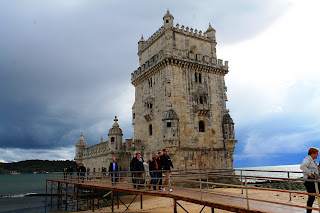
On the first day that Maddie and I were in Lisbon, we took the tram to the neighborhood Belem to see the Jeronimos Monastery, which is mostly famous for its beautiful cloisters, and the Torre de Belem. Belem is a bit of a ways from the center of Lisbon - probably about a half hour ride on
| Madds & me, Torre de Belem |
| Torre de Belem |
| Cloisters of the Jeronimos Monastery. |
The next day we originally planned to go to Evora, a town known for its Roman ruins, a Roman temple in particular. However, this day was a holiday and apparently many of Portugal's tourist sights close down on holidays. Stupid. So instead of taking a two-hour bus ride both there and back and running the risk of not being able to go inside anything in Evora, we took the train to Cascais, a pretty little beach/fishing town not too far away. Obviously at the beginning of May we weren't exactly looking to go swimming, but we walked around the small town, saw a boatload of boats, and took a long walk along the coast to the Boca do Inferno (Hell's Mouth), which is a deep chasm in the cliffs along the ocean.
| Cliffs near Cascais |
| Boca do Inferno |
Our last day in Lisbon was a rainy one. Actually it was worse than a rainy day - it was one of those days that goes back and forth between heavy rain and no rain at all. You try to be grateful for the
| Igreja do Carmo, or what remains of it after the 1755 earthquake. |
| View of Lisbon from the fortress/castle. |
And thus ended our trip to Portugal. Boo. But then it was time to show Maddie what Spain is like, so yay for that! Great trip(s) overall, and I think she had a good time as well.
Suscribirse a:
Entradas (Atom)