If you've ever traveled in Spain, north of Madrid, you've most likely seen an enormous cross off in the distance in the mountains. It's virtually impossible to miss. After all, that was the purpose of its location (in the Guadarrama mountain range, over 900 meters above sea level) and size (150 meters tall) - it can be seen from over twenty miles away. Seeing as Madrid has an average of over 300 days with sunshine each year, many of which include cloudless skies, that massive cross is in the perfect position for optimal viewing, whether the people of Spain like it or not.
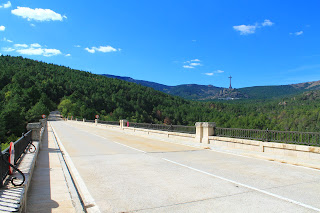 |
| View from only a few miles away during my hike up to it. |
This cross belongs to a 3360-acre complex called - if you hadn't already guessed - Valle de los Caídos, which translates to Valley of the Fallen. I could probably go on and on about the place - its history, its purpose, its significance, its position as perhaps the most controversial monument in Spain, etc., but I'll try to give you an abridged version (explained to the best of my knowledge)...ha ha...if that's possible. But anyway, it's because of the last reason I listed - the controversy over the monument, that I think I find it so interesting.
If you didn't already know, Spain, not unlike much of the rest of 20th century Europe, went through a period in which it was under the rule of a dictator. This period, known as Francoism, began in 1939, when General Francisco Franco's regime won the Spanish Civil War, and ended in 1975, when he died. Unlike many other dictators of 20th century Europe, Franco was anti-communist (which led the US to ally with Spain during the Cold War, but that's a tangent I'm not going to get into). Instead he supported a fascist political movement called the
Falange Española de las Juntas de Ofensiva Nacional Sindicalista, and as a result, Spain suffered religious, cultural, and political oppression for nearly forty years.
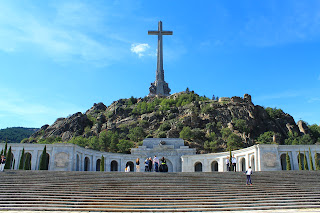 |
| Cross and basilica. The monastery is on the other side of the hill. |
During his time in power, Franco decided to create a memorial to all of the Spaniards who died during the Spanish Civil War in the 1930s. Official records state that 33,700 people are buried there. Franco also ordered that José Antonio Primo de Rivera, the founder of the Falange political movement, be buried in the basilica built under the cross. The tomb of Franco himself is also in the basilica, although this was not his wish. For this reason, among many others (including the facts that the monument commemorates those who helped support and fight for Franco's political cause and also that political prisoners were used to build the monument in an exchange for reducing their sentences), Valley of the Fallen has always been a point of contention in Spain. I've met plenty of Spaniards who haven't ever visited the monument and some who say they never will because of what it stands for.
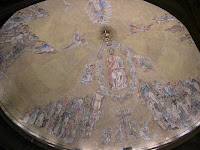 |
| Ceiling of the basilica, right under the cross. |
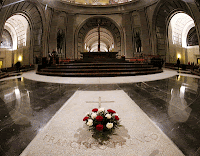 |
| Franco's tomb. Many want to relocate it. |
In 2009, the government led by then Prime Minister Zapatero closed down the basilica at Valley of the Fallen, saying that many of the statues, including the one below,
La Piedad (Catholicism was the only religion tolerated under Francoism), was in serious need of restoration and was therefore a safety concern. This angered many people, some who still support the things for which Franco's government stood, some who consider the monument to be of cultural importance, etc. I find particularly interesting that one particular group called the government "Talibanes socialistas," comparing the situation to the destruction of the Buddhas of Bamiyan, because supposedly the removal of the sculpture was destroying its integrity. (I'm not convinced of the correlation.)
 |
| "La Piedad." |
Anyway, when I arrived in Spain in the summer of 2010, I was a bit disappointed to realize that I couldn't visit Valley of the Fallen. Regardless of the significance behind the monument, I think it's an important part of Spanish history. (I have similar feelings about Nazi concentration camps - they reflect a terrible period in what is still very recent history, but they should be preserved as a reminder of things that should never happen again.) For this reason, when I originally posted my list of 101 Things to Do in Madrid, I wrote that "this one probably won’t happen because it’s been closed since November of 2009 with no reopening in the foreseeable future." However, it was reopened in November of 2011, following Rajoy's election as Prime Minister.
So I decided to spend this past Saturday in the sierra. The only public transport from Madrid takes you to the entrance of the complex, which is at the bottom of a hill 3.5 miles from the actual cross, basilica, and monastery. I think I spent more time walking up and down that road than I did actually at the monument. (Later I discovered if you travel to El Escorial first, there is a bus that takes you all the way to the monument, but it only makes one trip there and back each day. Still, worth it if you're not in the mood for a hike.)
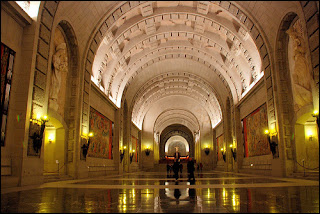 |
| Hall leading to Franco's tomb. There are no windows in the basilica. |
|
|
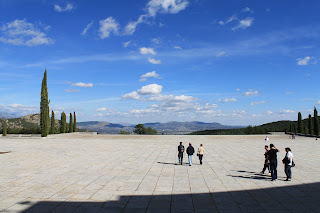 |
| Beautiful scenery as you walk out of the basilica. |
Anyway, the place is a unique and bizarre mixture of mega creepy/disturbing and serene beauty. The mountains, the scenery, the views from up there - are beautiful. The dark, windowless tunnel in the giant tomb-basilica and the gigantic cross - are, for lack of a better word, creepy. While I'm not sure that I would say that I
like the place, I do still find it fascinating (the most interesting things are the things that are most controversial, after all, right?) and worth a visit.


