Mostrando entradas con la etiqueta Europe. Mostrar todas las entradas

martes, 6 de agosto de 2013

Zadar, Croatia: a beautiful disappointment

As you  may or may not know, last Semana Santa I spent in Slovenia and Croatia. Both countries are really beautiful, and surprisingly (or maybe not), quite different despite their geographic locations and histories*. Croatia has some of the most beautiful coastline I've ever seen (which perhaps isn't saying much), and also some of the most delicious food. Of course, as we were there at the end of March, tourist season hadn't quite started yet, and this was good and bad - good because places were much less crowded than I would imagine they are in the summer, and bad because some things that we really wanted to see weren't open during the winter.
Driving along the coast between the cities of Zadar and Trogir.
Zadar in particular was a city that we really loved - it's small but compact, with lots of churches, ruins, museums, and little pedestrian streets. It's on the coast in north of the Dalmatia region so it has great views of the Adriatic Sea.

Zadar's Sea Organ (at high tide)
And yet, despite Zadar's charm and beauty, it was perhaps the biggest disappointment of the trip (unfortunately, there were a few in total). This isn't to say that I disliked the city - on the contrary, it was actually one of my favorite cities. However, Zadar is known in part for two quirky and really cool things, both designed by the same architect: the Sea Organ and the Greeting to the Sun.

The Sea Organ is a series of 35 pipes that extend 70 meters along the coast. As the waves move and the tides change, the pipes play different chords and tones, creating literally some of the most unique music of mother nature possible. Very cool.

Zadar's Greeting to the Sun: what we hoped to see.
The Greeting to the Sun is an enormous circle of various glass plates set into the sidewalk of the waterfront. Under each of the glass plates are "photo-voltage solar modules through which symbolic communication with nature is made, with the aim to communicate with light" (as the Sea Organ "communicates with nature" through sound). When the sun sets, the circle is lit up in different ways, creating what Zadar's tourism board calls the "most beautiful sunset in the world." As I'm sure it's difficult to imagine what this strange attraction is like, there are a couple photos on the left taken from Google.

The circle is its own little mini solar power plant (producing energy to spare), which I think is pretty unique and cool.

Sadly, we sat on the waterfront long after the sunset, waiting for Zadar's #1 attraction to work its magic. When we were finally about to give up, I head a tourist nearby ask a passing local what time the circle usually starts its light show. The local responded that it was currently broken, with no known date to repair it. So, sadly, the only views we got of the Greeting to the Sun were like this:
Greeting to the Sun: what we actually saw.
Definitely a disappointment. But Zadar still should not be missed - even if you can stop for a few hours to walk around, it's still highly worth it.


*Both countries belonged to the former Yugoslavia, but Slovenia was of the first countries to break off and gain independence, and they became more financially stable long before the other former states - and still is, as it is the only of the former states to be part of the European Union (until Croatia just joined this past July 1st) and the only country to officially use the euro.

sábado, 12 de enero de 2013

Switzerland

At the very beginning of November, we had a holiday here in Spain. Doesn't really matter which one, and quite frankly I don't even remember. A day for some saint or religious figure, surely. Anyway, the holiday fell on a Thursday, which meant that my school also got Friday off. I took advantage of the four-day weekend and took a little trip to Switzerland. I flew to Basel, in the northwest corner of the country right where it borders France and Germany, and stayed there for three nights. Since Basel is pretty small, though, I spent the first day there, the second day in Freiburg (Germany), and the third day in Zurich.
View of Lake Zurich and Swiss Alps from the Üetliberg Mountain.
Basel and Freiburg were both nice little towns, but I really, really loved Zurich. This is partly because I had great weather in Zurich (the only day it didn't rain on me - it was actually sunny pretty much all day). The city definitely wouldn't have been as pretty and I wouldn't have gotten great views of Lake Zurich and the surrounding mountains if the weather had been rainy, or even cloudy. The only downside to Zurich - or anywhere in Switzerland really - is that it's expensive. They don't use the euro, and even though one Swiss franc is about equal to one euro, prices are crazy. I ate a sausage for lunch in both Basel and Zurich because the meals in sit-down restaurants seemed to run around 20 Swiss francs, minimum. (I didn't complain one bit though: even though I actually kind of despise Spanish sausage and don't care at all for Italian sausage, I cannot get enough of Swiss/German sausage. As someone once said to me, it's basically an art form there.)
Lunch in Basel.
Anyway, auf wiedersehen und gute nacht.

jueves, 27 de septiembre de 2012

Polska

I've gotten the question several times, "why Poland?" The honest answer was a combination of: I wanted to go somewhere I knew little about, somewhere different from western Europe, somewhere not too touristy, and somewhere that I wasn't sure would be a safe place to travel on my own (it is completely safe, by the way, I've just read to avoid night trains).
Panorama of Krakow.
Poland was the first surprisingly excellent choice I made for travel this summer (the other being my first-ever solo trip to Sweden, Estonia, and Cataluña in northern Spain, but more on that in another post). I had relatively high expectations for Poland, and they were more than exceeded, in Krakow in particular. The whole country, from the Tatra mountains at the southern border with Slovakia to Warsaw (I really still can't believe that this city was more than 85% destroyed during WWII and managed to rebuild and bounce back in a matter of only about 20 years - incredible) to the Baltic coast, is all really beautiful. And, like Hungary, everything is really cheap and the cuisine is awesome (provided that you like potatoes, cabbage, sausage, and dumplings, to all of which I say, keep it comin').
Morskie Oko, the largest glacial lake in the Tatra mountains.
Sunset in Torun.
PIEROGIS!
So anyway, this blog is really more supposed to be about Spain and the joys of living here, so I'll keep the non-Spanish stuff to as much of a minimum as I'm capable. I'll leave you with two things:

1. in Poland we went to the cities/towns of Krakow, Zakopane (in the Tatras mountains), Warsaw, Torun, Malbork, Gdansk, and Poznan,
2. and a piece of advice - if you have the chance to travel to Poland, do it. It's so underrated and so worth the visit.

martes, 28 de agosto de 2012

Hungary (and a little bit of Slovakia!)

I can honestly say that before I visited Hungary I really knew nothing about the country. I'd seen amazing pictures of Budapest and heard great things as well, but in terms of central (and eastern) Europe, my knowledge is basically non-existant. (Is there a reason why in high school I had three years filled with the pilgrims, the American Revolution, and the US Civil War, and yet we never got past WWI - during which, by the way, I still have no idea what happened? Something about some archduke being assassinated? Anyway, my point is that my European history is extremely limited and I think the only things I know about communist/Soviet occupied Europe I've learned by visiting formerly occupied countries...yes, America, there are other countries in the world besides you.) Anyway, tangent aside, I learned a lot about Hungary and even central Europe just in the five days we were there. And the country (and city of Budapest) is really beautiful.

View of Pest across the Danube from the Fisherman's Bastion in Buda.
What else can I say about Hungary? Well, for one thing I have two pieces of advice: you should absolutely go, but you should absolutely not go in July or August, unless you're a masochistic person who enjoys high temperatures and intense humidity. Hungary seems to be doing an okay job, economically speaking, but it's still not western Europe. This obviously means a lot of things, but what I'm trying to say is that air conditioning is scarce, and well-functioning AC is even scarcer. We had an extremely miserable first night's sleep until we discovered that - thank God - the window actually DID open. We also had a pretty brutal train ride to a little town called Visegrad. But enough about that.

I'm not going to give you a detailed account of what we did during our trip because, well, I think that's pretty boring. And my pictures will give you a better idea of that anyway. What I will tell you is that aside from a few days in Budapest, we also took day (or half-day) trips to the little towns of Visegrad, Szentendre, and also the larger city of Bratislava, the capital of neighboring Slovakia. We loved Budapest and Bratislava. The other Hungarian towns were nice and pretty but nothing too spectacular.
Bratislava - isn't it pretty?!
The last thing I'll tell you about Budapest is that one of the best things I did (I use the word "best" instead of "favorite" intentionally, and you'll understand why) was a relatively new museum called the House of Terror. I know what you're thinking, I was too - sounds like some cheesy horror museum or haunted house tourist trap. Well, horror, yes; cheesy, not quite. The name is, unfortunately, very fitting. Basically, the museum covers the Nazi Germany and Soviet occupations of Hungary during the 20th century. Let me tell you - this country had it rough. They had a tough time recovering after the first World War (during which they lost 70%
House of Terror
of the country's territory) and as a result, had a difficult time fighting off Nazi Germany and not just one, but two periods of Soviet occupation (Hungary was never a Soviet state but they had a communist government both before and after WWII). So anyway, the building in which the museum is housed was actually where both the Gestapo and the communist government had their headquarters. Particularly during Soviet occupation, it was no secret that torture, imprisonment, and executions were going on in the foreboding, gray, Soviet cement block-like building. Thus its nickname.

So there's my Budapest trip in a nutshell (maybe...I'm not very good at keeping things short). Great trip, great food, and beautiful city(ies). Just oh so hot and sticky.

lunes, 16 de julio de 2012

Sintra: Fairy Tale Land

This is going to be a short post. Because, well, frankly the trip to Portugal was just too long ago and I have more recent places (Hungary and Slovakia!) and things (how I survived my first year teaching preschoolers English!) to be updating about. And no one really wants to read my long-winded blog posts anyway, so short and sweet it is.

The first time I went to Sintra, I thought, oh, this will be a great day trip. Day trip my culete. Most people do spend only one day in Sintra, and shame on them. Not only is there really a lot to do there (after two days there with Maddie I left still without seeing everything that I wanted to see), but the town is so peaceful at night when all the tourists are gone. And it's in the mountains, so the view of the countryside at dusk is really beautiful. Anyway, we spent the first day in Sintra seeing things that I didn't have time to see when I was there the first time - the Sintra National Palace and the Quinta da Regaleira palace. Both were really awesome, but the latter in particular. The palace at Quinta da Regaleira is really neat, but its perhaps more famous for its insane gardens, which include lots of fountains, statues, an old tennis court, towers, and a bunch of caves and tunnels. I felt a little like I was in some sort of Portuguese Lewis Carroll land.
Quinta da Regaleira Palace
Initiation Well - one of the quirky things in the gardens - from the top.
Initiation Well from the bottom.
The next day we went to the Pena Palace and the Moorish Castle, both of which I'd been to the first time around, but I enjoyed revisiting them. The Pena Palace is located in a big park that has a lot of similar quirky things hidden about just like the Quinta da Regaleira, so we spent a good portion of our time there exploring the park alone. And enjoying the view of surrounding Portugal and the Atlantic Ocean from up in the mountains.
View of Pena Palace from the highest mountain in Sintra.

Pena Park.
Chances are, I won't go back to Sintra again any time soon, if at all. (The world's just too big - too many other places to see.) BUT, if I did, the one other thing I really would have liked to have seen was the Monserrate Palace. It apparently has a lot of Islamic-style architecture and interesting gardens (I think I remember reading somewhere that the gardens are divided into sections of exotic plants from different parts of the world). We actually would have had time to go there, except that the palace is a few miles from the center of Sintra so you really need to take a bus. However, the stupid bus stops running an hour or two before the palace closes, what kind of sense does that make? Grrr! Anyway, apparently there's also an antique toy museum in Sintra that perhaps would have been interesting. And there's a famous convent with nice gardens, but you have to have a car to get there, so that was always a no-go (but I guess you really only need to see so many gardens...).

So, to sum up: if you're ever in Lisbon, don't miss Sintra!

I left my heart in...Lisboa

San Francisco? Rio? Lisbon!
I'm not really sure why, but I love Lisbon. I think it's really Portugal in general that I love, actually. It's just a really beautiful country, the people are nice (and they speak English!), the food is awesome, and it's a great and super easy place to go to get away from Spain for a little bit. I haven't seen a ton of Portugal, but among the cities that I have been to (which are all quite different, by the way), Lisbon is my favorite. There are so few cities in the world that I've visited that I think I could actually live in, and Lisbon is one of them. But anyway, back on track. Back at
Just look at it!
the end of April/very beginning of May I had a five-day weekend, and I figured, let's go back to Lisbon. I spent three days there back in December, one of which spent in Sintra, a magical little town about half an hour away from the capital. So really we were only in Lisbon for two days, and even though there's not a ton to see in Lisbon, it wasn't enough (not to mention, the weather on the last day was pretty bad; it down poured most of the morning). This time I dragged Maddie with me (although dragged is a bit of an exaggeration, because she's been asking to go back since we left). We spent five days in Portugal - two or so in Lisbon, two in Sintra, and about half a day in Cascais, a pretty little beach town less than an hour from Lisbon. And while I'm now going to hold off returning to Lisbon for a third time for a while, I would still love to go back.

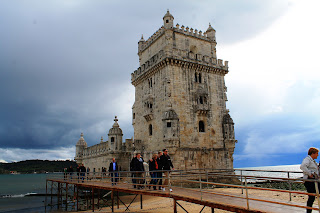
On the first day that Maddie and I were in Lisbon, we took the tram to the neighborhood Belem to see the Jeronimos Monastery, which is mostly famous for its beautiful cloisters, and the Torre de Belem. Belem is a bit of a ways from the center of Lisbon - probably about a half hour ride on
Madds & me, Torre de Belem
the tram, what with all the stops it makes, and on the way back another American decided to strike up conversation with us. This guy had been living in Russia for something like ten years now, and clearly it was getting to him. One of the first things he said to us was, "Lisbon is so awful. This city is shit. I don't know why people come here." Luckily Maddie will talk to anyone, because I really wasn't too enthusiastic too dignify his comments with a response. I guess his life story was, from Detroit (that's perhaps saying something right there about his views on nice cities), living in Russia for a while, doing some sort of PhD research there, was visiting Lisbon because his wife or girlfriend or whoever the girl was with him had some sort of conference she had to attend there. The only places in Europe that he likes are Poland and Croatia. And Andalucia in Spain. Come on, dude, get over yourself. I'm not necessarily a big fan of the cliche European cities that Americans always visit; Paris is just ok, and I'm in no rush to visit Rome or really anywhere in Italy. (I admit, London is pretty damn awesome though.) But there are lots of beautiful cities in western Europe, Lisbon included.
Torre de Belem
Cloisters of the Jeronimos Monastery.
Anyway, after that bizarre conversation, Maddie and I spent the next two days in Sintra. I'm going to write a separate post about Sintra - but rest assured, it was awesome. So after our sad departure from Sintra, we got back to Lisbon and did some walking around Lisbon at night. Finally by this point Maddie was able to stay awake past 9 pm (really, though, she got accustomed to the time difference pretty quickly, especially considering how much sightseeing I made her do on her first few days here). We did a little exploring around the Bairro Alto, or the Upper District, one of the hilliest neighborhoods of Lisbon, had some awesome Portuguese food in a tiny family owned restaurant recommended to us by the people in the hostel in Sintra, and listened to some of the many street musicians that are so common in Portugal (and Spain). I wanted to upload a video of said street performers, but blogger for some reason won't let me, so I'll have to try it in a separate post.

The next day we originally planned to go to Evora, a town known for its Roman ruins, a Roman temple in particular. However, this day was a holiday and apparently many of Portugal's tourist sights close down on holidays. Stupid. So instead of taking a two-hour bus ride both there and back and running the risk of not being able to go inside anything in Evora, we took the train to Cascais, a pretty little beach/fishing town not too far away. Obviously at the beginning of May we weren't exactly looking to go swimming, but we walked around the small town, saw a boatload of boats, and took a long walk along the coast to the Boca do Inferno (Hell's Mouth), which is a deep chasm in the cliffs along the ocean.

Cliffs near Cascais
Boca do Inferno
I'm betting that during tourist season, Cascais is not the place to be (well, unless you're looking for a place overrun by tourists), but at the beginning of May it wasn't too busy, and the scenery was still beautiful. And despite there not being a whole lot to do or see there, it's another nice little getaway from the hustle and bustle of big city life. We ended the day with this great seafood stew that was really like nothing I'd ever had before, mainly because it was thickened (a lot) with breadcrumbs. It was bizarre, but in a good way. Maddie still has an ongoing obsession with said stew - one that I don't see ending any time soon, and rightfully so.

Our last day in Lisbon was a rainy one. Actually it was worse than a rainy day - it was one of those days that goes back and forth between heavy rain and no rain at all. You try to be grateful for the
Igreja do Carmo, or what remains of it after the 1755 earthquake.
no-rain parts of the day, but you can't help but get frustrated by having to take out and open your umbrella, close your umbrella once the rain stops, carry it around because it's too wet to put away, finally put it away because it's finally dry enough, and then BOOM it starts raining again. It's a vicious, watery cycle. Aaaanyway, we tried to spend the day at places inside, but there actually aren't a whole lot of sights that are completely inside. First we went to Igreja do Carmo, which was a church that was turned into an archaeological museum after an earthquake destroyed a lot of it in the 1700s. Sadly, the part of the museum that's inside is small, and the rest is the structure of the church, sans roof. But well worth the visit either way.
View of Lisbon from the fortress/castle.
Next we moved on to the cathedral of Lisbon, which actually wasn't majorly impressive. But it was inside, so that counts for something. Our last sight was the castle on one of Lisbon's biggest hills, overlooking the entire city. Not inside at all, but it had stopped raining by this point in the afternoon. We ended the day with a bit more walking around and enjoying the pretty Portuguese architecture, complete with a nice relaxing break from the hectic sightseeing for yummy Portuguese pastries. I've probably said it before, but Portugal has awesome pastries.

And thus ended our trip to Portugal. Boo. But then it was time to show Maddie what Spain is like, so yay for that! Great trip(s) overall, and I think she had a good time as well.

lunes, 28 de mayo de 2012

Last stop: Vienna

I don't mean to start this post off on a bad note, but I've gotta say: Vienna is overrated. Don't get me wrong, it's a pretty city and there's a lot of interesting things to see there. But I heard from lots of people that it was amazing or the most beautiful city they'd been to or other things along those lines. So I had very high hopes. I guess to look at this in perspective, Vienna did have a couple things going against its favor. For one thing, it was the last of four cities on a ten-day-long trip. We were tired. A little sick of traveling. Longing for our own beds at home. Another problem was the weather. I can stand the cold. I don't like it, but I am from the northeast and we do get some relatively cold winters, so I'm used to the cold. What I don't like is constant cold, rain, and wind. That was day one in Vienna. Day two was freezing cold with a bit of snow. And lots of wind.

Okay, so not ideal. I told you this wasn't going to start out on a positive note. But I've gotta add one more thing to this list, something that kind of is Vienna's fault: the city, though not exactly huge, is overwhelming. Or at least it was for me. There are a lot of things to see there and they're all spread way the heck out. What also didn't help this situation was the fact that the only map we were given was this ridiculous, gigantic map of the city that wasn't really ideal for tourists. Sure, it had a blown-up map on the back of the city center, but that isn't much help when half of the things you're looking to see aren't in the city center. So basically I spent two days looking like a stupid little lost tourist, folding and unfolding my map and yelling at it as it tried to blow away from me in the wind while I was holding it with one hand and my umbrella in the other.

Brrr. I am cold. Don't let the smile deceive you.
All right, enough of that. Now the good stuff. There were some things that I really liked about Vienna, and actually, I think my favorite thing of the entire trip was a museum we went to there (more on that later). So as I said, there's a lot to see in the Austrian capital: many museums, a few palaces, lots of parks, lots of churches, one of the world's most famous opera houses...too much for just two days. So of course we had to narrow it down a bit, and in doing so we had to do a few solo tours of the city. Day one we started in the historic city center. We checked out the cathedral, another really beautiful church, and some of the main squares and streets. Then we went to the opera house for a tour. We briefly debated waiting in line for standing room opera tickets for that night, but then decided touring the place was enough. I do wish we'd had a chance to go (I've never been to the opera, and I think it would probably be an interesting experience), and I think if we'd had more than two days in Vienna, we may have done it. Oh well, next time.

After the tour, we split up to go to different places. I went to a small art museum called the Vienna Succession, which was opened around the turn of the 20th century. The museum space has the same name as a movement began by artists and architects, led by painter Gustav Klimt. The group held several exhibitions, the most famous of which (in 1902) was one dedicated to Beethoven and included a work that remains in the museum today: the Beethoven Frieze. The work, by Klimt, is basically three mural-sized paintings that cover three walls of the exhibition room. It's probably best for me to just quote the pamphlet that I got at the museum in regards to the work's meaning or purpose, since I know and understand very little about art: "The frieze takes its theme from Richard Wagner's interpretation of Beethoven's Ninth Symphony and depicts humankind's search for happiness." There's a lot to the work (which thankfully the pamphlet explains, otherwise I think I would have been pretty lost), but it's really only best seen in person. Since it's displayed on three walls, seeing an image online doesn't really give you the same experience. I thought it was pretty cool, though. The rest of the museum wasn't really my sort of thing (modern art, ew), but it was worth going to just for the Beethoven Frieze.

Anyway, after the Succession, I wandered over to Belvedere Palace, which is a palace used as an art museum. I'm not really much into art, but I started to actually really like Klimt's work, and there are a lot of his paintings at Belvedere, including one of his most famous ones, The Kiss. Unfortunately, I didn't really have enough time to go into the museum, and decided to just walk around its gardens instead. Next time.
Front view of Belvedere Palace.

On the second day, Nicole and I went bright and early in the morning to the Schonbrunn Palace, which is a bit outside of the city. And good thing too, because we had to wait a little while before we could enter the palace, and when we left the line just to buy tickets was insanely long (and out in the cold!). Anyway, the palace was built in the 16th century as the summer residence of the Austrian royal family. It has some really beautiful and extensive gardens, which we spend a while exploring. Once we'd had enough of the freezing cold and the wind (and a little bit of snow), we headed back into the center of Vienna for lunch and some more wandering around. Not sure why we decided to do that in the cold, but we did. We first went to Stadtpark, a park dedicated to famous Austrian musicians and composers. Interesting, but a little underwhelming. After that we decided we really deserved some sort of hot beverage. And Austrian pastry. Yum.
Back view of Schonbrunn Palace.

Fountain in the gardens of Schonbrunn.
After our snack/respite from the cold, we went to the Haus der Musik. This was perhaps my favorite thing of the whole Germany-Austria trip. I'm not really much of a musician and I don't know a ton about music, and I've forgotten a lot of what I did learn. But I did spend somewhere around thirteen or fourteen years playing the violin, and this museum, well...made me miss my violin. Basically, this museum is just dedicated to music, as simple as that. The first floor has some historical information about the Vienna Philharmonic, a video playing the latest Vienna New Year's Eve concert (so cool), and a few other things, including a wicked awesome (that's right, so awesome I'm pulling out the "wicked") game where you and a partner each roll a set of dice to compose your own waltz. Anyway, the second floor has all different things about sound - the physics of it, how we perceive it, etc. The third floor is dedicated to the most important Austrian composers, including Mozart, Haydn, Beethoven, etc. Each room is dedicated to the life and career of each composer. Unfortunately, we didn't get to the 4th floor because of time, so I don't really remember what would have been up there. Anyway, the museum is so worth going to, even if you don't know much about music. And it's so interactive (especially the floor dedicated to sound).

Anyway, so there's my long spiel on Vienna. Hopefully I haven't discouraged anyone from visiting, because it is a nice city. Just not my favorite. Perhaps if I went back I would have a better experience.

So there. Whew. Finally, only about two months later, I'm done writing about Semana Santa. If you've made it this far reading...well, you're a trooper. Auf wiedersehen for now.

sábado, 26 de mayo de 2012

Salzburg, Austria: a Few of My Favorite Things

Ah, Salzburg. Aside from the weather (and a few other minor things), this city doesn't disappoint. It's not too big, it's really pretty, and it's where The Sound of Music takes place and was filmed. How can a city where The Sound of Music takes place not be a happy place?!
Just look at it. Convinced?
I'm starting to sound like a guidebook. But really, even in the cloudy and rainy weather that we had while we were there, Salzburg is still really beautiful. We started our first day there by doing a Sound of Music tour (for anyone who's rolling their eyes: get over it, you and I both know you're just jealous). The tour first brings you a bit outside the center of the city to the house that they used for its back terrace and the lake where Maria and the children go boating and then fall in right when they see the Captain and the Baroness. They also bring you past the house that was actually used as the front of the von Trapp house, as well as the Hellbrunn palace, whose grounds house the gazebo used for "Sixteen Going on Seventeen" and "Something Good." You used to be able to go inside the gazebo but then some old lady broke her hip or something and so they decided to close the gazebo off to visitors. Thanks a lot, old lady.
Well, uh, the gazebo.
House used for the back terrace.


Anyway, after we stopped briefly at these places, we drove off into the mountains/lakes region outside of Salzburg on the way to the town of Mondsee, where the church that they used for Maria and the Captain's wedding is located. We had just enough time in Mondsee to see the church (very pretty), the lake and surrounding mountains (even prettier), and eat apfelstrudel (yum yum!). I think doing the tour was worth it most of all because they bring you to Mondsee, which aside from being a nice little town, allows you to see some great Austrian scenery on the trip there: the mountains, the lakes (which are especially beautiful), and the cute little Austrian mountain villages.
One of the lakes, about half an hour outside of Salzburg.

The tour dropped us off in front of the Mirabell palace, which is famous mostly for its gardens, which Maria and the children ran through singing "Do Re Mi." We explored the gardens for a while and then afterwards headed over to the city center (the historic part). The historic center is pretty small; you could easily walk from one end to the other in maybe twenty to thirty minutes, but there's a lot to see and as I said, it's really pretty. There are several little squares, many churches, markets, levitating Mozarts, a really impressive cemetery (weird combination of words, I know), and several other little monuments made famous for all of time thanks to The Sound of Music. We spent the rest of our first day after our Sound of Music tour just walking around. Mainly we visited the cathedral and then walked to the Nonnberg Abbey, where Maria (both the real one and the Sound of Music character) was a postulant. I think they were only allowed to use the outside of the abbey for filming, though.
Entrance to Mirabell Gardens. Look familiar?
The second day in Salzburg we went up to the Hohensalzburg fortress/castle. It's one of the largest and best preserved medieval castles in Europe, and really, it's more like a mini town atop the hill overlooking Salzburg. There's a big courtyard with a few paths leading off of it to several buildings (the main part of the castle, the chapel, etc.). You also get probably the best views of the city from up by the castle. Anyway, after spending plenty of time exploring said castle and eating lunch there (I guess it's kind of cool to say I ate lunch in a castle?), Nicole and I went to check out the museum at Mozart's birthplace. Yep, if you didn't already know, Mozart was born in Salzburg and lived there for a good portion of his short life. The birthplace is interesting, but really more of a traditional museum; very little to none of the original furniture or possessions of the Mozart family remain there. However, his first violin is on display, which I thought was pretty cool.
View of the castle and cathedral from the Mozart bridge.

Only a fraction of all the Easter eggs...
Now, since of course our trips to Germany and Austria were during Spain's Semana Santa, this means that Easter was approaching. Apparently coloring and decorating Easter eggs in the German-speaking countries is really popular (in Spain, not so much). We came across lots of colored eggs in outdoor markets, but nothing compared to one particular store we came across in Salzburg. It was
I thought thiese were pretty sweet.
really a store for decorations in general, I think, but at this time of year the ENTIRE store was filled with decorated eggs. And not just different colored eggs. Eggs with flowers, eggs with bunnies, eggs with geometric designs, eggs with maps of the world, you name it. Seriously. I have never seen so many egg shells in my life. It was incredible and terrifying at the same time (I mean, you get too close and one misstep and you break like 300 euros worth of egg white- and yolk- free egg shells). But mostly it was really cool.

Coming up, our next and last stop: Vienna.

domingo, 13 de mayo de 2012

Deutschland - First Stop, Heidelberg

I guess it's about time I start catching up, particularly with our German-Austrian Semana Santa trip. I mean, I could be planning my lessons for tomorrow, but why do that when I could instead be entertaining the masses with stories of airport mishaps and giant, deathly pastry balls and singing, dancing clocks and Easter egg hunts and schnitzel (LOTS of schnitzel), just to name a few. Oh, and of course pondering the timeless question: how DO you solve a problem like Maria?

I'll start by saying this trip was awesome. However, I'll also start by saying that this trip did not start awesomely. It was a warm and peaceful Friday in Madrid, that 30th day of March. We were done with school for 10+ days, luggage packed, ready to go at the airport. Flew to Frankfurt successfully (from which we would take the train to Heidelberg the next morning). By "successfully" here, I mean that we flew Ryanair without dying. I do not, however, mean we flew to "Frankfurt," per se. See, for those of you who haven't had the pleasure of flying with Ryanair, you may not know that many of their flights go to small airports well outside of the main cities they claim to fly to. For example, if you take them to Paris, it actually brings you to Beauvais, and from there you have to take a bus for about an hour and a half to Paris. Luckily, I knew this when I flew to Paris four years ago. And when I flew to London last April. Unfortunately, we neglected to do our research on Frankfurt. Long story short, we wound up in the Frankfurt Hahn airport and not the Flughafen Frankfurt am Main airport. Two good, long hours away from Frankfurt vs. about fifteen minutes. Already the German language getting the best of me. Swell.

Nevertheless, we made it to Frankfurt, albeit at nearly three in the morning. The next day we caught our morning train to Heidelberg. Let me just say that, despite the cloudy and somewhat rainy weather,
Courtyard of the castle
Heidelberg gives a great first impression of Germany. It's a relatively small city with a really charming old town and a pretty sweet old castle. There are a lot of tourists, but it's not too overwhelming, and it's just plain pretty. We had two days in Heidelberg. Days one and two were mainly spent the same way: walking around the old town, visiting the castle, eating lots of schnitzel. The castle is a huge structure that to me is part castle, part palace, part fortress, part miniature town. Most of it is still in ruins after destruction in both the 17th and 18th centuries, so a good portion of the buildings are just old facades surrounded a huge courtyard, which to me is more like a plaza. Anyway, the original buildings of the castle were build around the turn of the 15th century. Various Prince Electors (whatever that is) added to the castle/palace/fortress structure at various
View of Heidelberg from the castle
points in history thereafter. The castle was destroyed various times, such as during the 30 Years' War, when both the castle and its gardens were damaged, and then later in 1764, lightening hit the castle. For this reason only some of the castle remains and has been restored. Apparently after lightening struck the castle, they gave up trying to restore it and people started using the castle as a makeshift quarry in order to build houses in town. Later on this was stopped in an attempt to preserve the castle. Today parts of it are still used for ceremonies, balls, performances, etc. The courtyard is also used frequently for musical and theatrical events.

One of the bigger cells of the prison
On the second day we dedicated the morning to checking out the Philosopher's Walk, which is located across the Neckar River from the old town, and the old university. On the side of a small mountain are a few pathways that university professors and philosophers would supposedly wander along in the olden days. It has great views of the old town and the castle. After we did some philosophical pondering, we headed back over to the old town to check out the old part of the Heidelberg University. The university was founded in 1386 and is the oldest university in Germany. It is apparently one of the more prestigious universities in Europe today. Anyway, as a tourist, I guess you can normally see the great hall, the old prison, and an exhibit about the history of the university, but the great hall wasn't open for visitors unfortunately. Luckily, the prison is probably the most interesting part (the stupid exhibit was mostly in
Graffiti
German). It was used from the late 1700s into the early 1900s as punishment for students who had committed petty crimes or pulled pranks - some normal, some ridiculous (for example, letting the neighbors' pigs loose, public intoxication, participating in duels, etc.). Depending on the offense, students could spend anywhere from a few days to four weeks in the prison. However, they were still allowed to attend lectures while they were imprisoned. They were also allowed to bring certain things with them and guests were allowed to visit and give them things (for example, bedding, food, beer). To help pass time, the students would write all over the walls of the small prison, and the most recent layers are preserved today, which is mainly what you see when you visit. It's a really interesting place to visit, but I really think you miss out on a lot when you can't understand what's written on the walls (obviously, it's in German).

I should explain its title. While in Heidelberg we discovered a couple of stores that solely sold a very specific type of pastry: the Schneeballe, or snowball. (Now, let's all admit that this, not unlike many other German words, makes you giggle a bit inside.)
A 10-cm diameter ball of pastry goodness
Traditionally, snowballs were these huge masses of pastry rolled up in a ball and dusted with confectioner's sugar and then served at special events like weddings. These snowballs actually come from an area in Bavaria, about two hours away from Heidelberg, but they've become such popular tourist souvenirs that I guess they've spread throughout southern Germany. Anyway, they sell them in a ridiculous variety of flavors with different glazes and/or fillings. They are delicious, but deadly. I thought only the US was capable of such ridiculously sized foods, but evidently not. They are not to be eaten in one sitting. But they are a must. (And as soon as I find a recipe, I intend to try making them myself. That ought to impress people: "Hey, whatchya making?" "Oh, just some schneeballes.")

So that was Heidelberg. As I said, a good introduction to Germany. Up next: more castles, more schnitzel, more beer, singing and dancing clocks, and more beautiful Germanness - Munich!

Video: Palm Sunday morning in Heidelberg.