Mostrando entradas con la etiqueta food. Mostrar todas las entradas

jueves, 11 de agosto de 2016

#15 Enjoy a pastry from Mallorquina

It had been years since I'd gone to the Mallorquina, even though I pass it pretty often. But then one day a few months ago I had to get a document from the government early in the morning before school, which happened to be near the famous historical pastry shop. I thought, okay I haven't had breakfast, let's get a napolitana, or basically the Spanish version of a chocolate croissant (though not shaped like a croissant). I seriously had forgotten how amazing they are. You'll definitely need a glass of water or coffee to wash it down because it is super sweet, but a melt-in-your-mouth, like nothing you've ever had before sweet.

When I was in the area yesterday and hungry for a snack, I couldn't resist yet again. Even though its such a touristy place, it's absolutely worth it, especially at only 1.30€!

sábado, 31 de agosto de 2013

The francesinha: Portuguese heart attack on a plate

Back at the beginning of June, Emilio and I decided to get away from Madrid for the weekend, and we chose Porto as our destination. Located in northern Portugal, Porto is so charming and laid back that you'd never guess that it's Portugal second largest city. It's particularly famous for its port wine - you can visit several bodegas around the city.
The famous Dom Luis Bridge over the River Douro
Porto is also famous for the francesinha, a heavenly creation that will unfortunately probably take a couple of years off your life. But it's ok; it's worth it. This typical sandwich of Porto is sort of their take on a croque-monsieur except, well, more artery-clogging (and way more delicious). It's made with several types of meat (typically different types of Portuguese hams, pork, and sausages) between two pieces of bread that are then covered with melted cheese and lastly, a tomato-beer sauce. Think that's it? That it can't get more unhealthy?
Believe me, the picture does it no justice.
Wrong. Served alongside it, drenched in the same tomato-beer sauce, are French fries. Down it with a Super Bock (one of the country's most popular beers, produced near Porto), and you're likely not to want to move for the rest of the day.

sábado, 12 de enero de 2013

Switzerland

At the very beginning of November, we had a holiday here in Spain. Doesn't really matter which one, and quite frankly I don't even remember. A day for some saint or religious figure, surely. Anyway, the holiday fell on a Thursday, which meant that my school also got Friday off. I took advantage of the four-day weekend and took a little trip to Switzerland. I flew to Basel, in the northwest corner of the country right where it borders France and Germany, and stayed there for three nights. Since Basel is pretty small, though, I spent the first day there, the second day in Freiburg (Germany), and the third day in Zurich.
View of Lake Zurich and Swiss Alps from the Üetliberg Mountain.
Basel and Freiburg were both nice little towns, but I really, really loved Zurich. This is partly because I had great weather in Zurich (the only day it didn't rain on me - it was actually sunny pretty much all day). The city definitely wouldn't have been as pretty and I wouldn't have gotten great views of Lake Zurich and the surrounding mountains if the weather had been rainy, or even cloudy. The only downside to Zurich - or anywhere in Switzerland really - is that it's expensive. They don't use the euro, and even though one Swiss franc is about equal to one euro, prices are crazy. I ate a sausage for lunch in both Basel and Zurich because the meals in sit-down restaurants seemed to run around 20 Swiss francs, minimum. (I didn't complain one bit though: even though I actually kind of despise Spanish sausage and don't care at all for Italian sausage, I cannot get enough of Swiss/German sausage. As someone once said to me, it's basically an art form there.)
Lunch in Basel.
Anyway, auf wiedersehen und gute nacht.

domingo, 25 de noviembre de 2012

Inventiveness

You may have noticed that I post a lot about food. Take a lot of photos of food. All in all just plain old eat a lot of food. Well, it just so happens that it's not your mind deceiving you; half of the time I'm pretty sure I'm thinking about food.

In my defense, food and foreign cuisines are much more interesting when you live in or travel to other countries. In my opinion, food is of much more cultural importance in lots of other countries than it is in the US. Take ham in Spain, sausage in Germany, pasta in Italy, pastries in France...you get the idea. And, I'll be honest. I just plain old like to eat. Luckily, at least thus far in my life, I have been blessed with relatively decent metabolism.
It may not look like much, but this sausage in Freiburg was amazing.
I'm much better at baking desserty things, but I've had to get creative and inventive when it comes to real food living here, whether it's making something American or attempting something Spanish. Don't get me wrong, plenty of things that I would make and eat all of the time in the US are super easy to make here, but some things are just crap. Take pizza here in Spain - I'm pretty sure a decent pizza simply doesn't exist. Anywhere. This literally bewilders me, because making a decent pizza shouldn't be all that difficult. And for chrissake, we're closer to freaking Italy here than in the States! So I've developed pretty decent pizza-making skills (dough and all - that's right).
Homemade pizza.
Anyway, last night I was invited to a Thanksgiving dinner event (which was a lot of fun and the food was amazing), and it got me thinking about T-Day leftovers. What the bleep you do with a leftover 20-pound turkey. For example. Since I had no leftover turkey, I improvised. In other words, I bought a (very small) whole chicken. The goal: classic chicken noodle soup. Spain knows how to make great bean soups and stews. But I think chicken noodle is an American classic, and I miss being able to pick up a can of it in the grocery store (not that crap Campbells stuff, by the way, something like Progresso) and then heat it up and am ready to go in a matter of minutes.

So long story short, I spent the day boiling away: first chicken (that thing barely fit into the largest pot we have), then chicken carcass with vegetable scraps, and finally vegetables, chicken, noodles, and homemade broth. You probably don't save on money (especially considering the gas or electricity you consume simmering things all day) if you live in the US and have the canned alternative. But once in a while, and if you have the bird carcass anyway, it's 100% worth it. Not to toot my own horn here or anything, but this is hands down the best chicken noodle soup I have ever had. And the best part is that I have a crapload of it leftover (so actually, I'll probably be really sick of it by Wednesday and then I'll be saying that I hate it).
Well, I'm going to stop glorifying my soup and obsessing about food...for the time being. Until next time!

viernes, 19 de octubre de 2012

It's Kaki Season!!!

I seriously do not know how I went twenty-four years of my life without this fruit. I discovered it last fall - they're called kakis here, persimmons in English - and I think I practically lived off it for three or four months. Then I spent about nine months eagerly awaiting the start of 2012 persimmon season.

Why so special, you ask? They're sweet, crunchy, have a fantastic, thick, pretty orange skin (I know, I'm weird, I always eat my fruit with the skin on, no matter how tough it is...unless it's like, an orange). Perfect for autumn. And, if you cut them horizontally there's a star in the middle, a bit like when you cut an apply horizontally.

Word of advice, though: there are two main varieties of persimmons, the gross variety (in my opinion), which is shorter and rounder and you have to let ripen until it's really soft and then you scoop it out; and the good version, which is slightly more elongated and eaten while it's firm. Mmm, I love crunchy fruit!


Edit: After some disconcerting research, I discovered that you shouldn't eat persimmons too often, and you shouldn't eat them on an empty stomach, especially with the skin on (i.e. basically the only way I eat them). Apparently they contain "a compound called shibuol" that doesn't react well with stomach acid and could eventually lead to digestive issues. I have no idea how much of a risk this is or if it applies to all different types of persimmons but...maybe just to be safe I'm going to stop eating them for breakfast every single day.

jueves, 4 de octubre de 2012

Made in the USA...Sold in España

Remember I wrote this post about American things (or things found in the US) that I miss because you can't find them in Spain? (Part Two is coming, hopefully soon, by the way.)

Well, here's a brief update on American products of a different category: things that you actually can find here in Spain and that I miss enough to pay ridiculously exorbitant prices for every once in a while.

1. Canned pumpkin.  Maybe fresh pumpkin is better (I don't know, I'm too lazy to have ever tried cooking with it), but even fresh pumpkins aren't very popular here. But to me, autumn = pumpkins. Among other things. But especially pumpkins. Not to mention Thanksgiving just isn't Thanksgiving without a pumpkin pie. So finding canned pumpkin is a once or twice a year necessity. I'm not sure if there are any Spanish grocery stores that sell canned pumpkin, but I've never seen it. If anyone ever has, please let me know! But anyway, I've always gone to Taste of America, where it costs €3 a can. Not terrible, but more expensive than I've ever seen at home. I recently bought a couple of cans to make pumpkin bread with, and it was totally worth it.

The cake mixes are perhaps the most overpriced - €6 or €7 a box!
2. Brown sugar.  The concept of brown sugar just doesn't exist here. They've got "azúcar moreno," which sort of is brown sugar (and is what that translates to), but in reality, it's only what we call raw sugar. Not the same as our probably extra-diabetes-enducing molasses-sugar mixture. Obviously this isn't something I use all that frequently, but I do like it on oatmeal and making certain baked goods, such as the good old chocolate chip cookie, is impossible without it. I also buy this at Taste of America - where it's generally about €1,50 - because I've never seen it in regular grocery stores either.


3. Peanut butter.  The funny thing is, I'm not really even much of a peanut butter fan. I love love love peanut butter cups or any other form of chocolate and peanut butter together, and I love it with apples, but I never eat peanut butter and jelly sandwiches, for example. I think it's the texture - it's just way too much between the stickiness/thickness of the PB and the bread. Anyway, I remember when I studied abroad here I brought a jar of PB, knowing that it was hard to find, and I went through that thing with lightning speed. I don't buy it often now, but I've found it in a couple of grocery stores and I therefore don't bother bringing it from the US. The latest regular-sized jar I bought cost me €4,50...which I do think is a lot for peanut butter...


Baking soda is also sort of a weird situation here - they sell what I think is the chemical equivalent here in grocery stores, but I think it's used more for cleaning than for baking. Normally it's only baking powder here. I've never tried this supermarket equivalent because I bought a box of way overpriced Arm & Hammer at Taste of America a couple of years ago and obviously I haven't even gone through a quarter of the box. I'm more likely to have to get new baking soda because this box is going to expire, rather than actually run out.
Sesame, onion, and plain bagels!


One last thing that is hard to find here in Spain, and when you do find it, it's usually not that great, is bagels. They actually sell them at Taste of America and also some specialty bakeries, but I've found it's much more cost effective (and let's face it, much more FUN) to make my own bagels. Mmmm.


So there you have it: these are the products that I occasionally like to pick up, mostly at Taste of America. (Notice how it's all food?) It's a cool little store (right by the NYU campus here), and they carry both food products and even American-style cookware, such as cupcake pans, cake decorating items, etc. They even have some weird products that I've never seen before (mostly brands, not actual foods), which is a funny, but seeing as America is pretty big, I guess I'm bound to not know ever brand ever in existence. Also, several times that I've bought stuff at Taste of America, they've given me random things free with my purchases - like this bag of Goldfish in the picture above. I don't even buy Goldfish often in the US, so I really can't remember the last time I've had them, but it was a nice little culinary reminder of home.

jueves, 27 de septiembre de 2012

Polska

I've gotten the question several times, "why Poland?" The honest answer was a combination of: I wanted to go somewhere I knew little about, somewhere different from western Europe, somewhere not too touristy, and somewhere that I wasn't sure would be a safe place to travel on my own (it is completely safe, by the way, I've just read to avoid night trains).
Panorama of Krakow.
Poland was the first surprisingly excellent choice I made for travel this summer (the other being my first-ever solo trip to Sweden, Estonia, and Cataluña in northern Spain, but more on that in another post). I had relatively high expectations for Poland, and they were more than exceeded, in Krakow in particular. The whole country, from the Tatra mountains at the southern border with Slovakia to Warsaw (I really still can't believe that this city was more than 85% destroyed during WWII and managed to rebuild and bounce back in a matter of only about 20 years - incredible) to the Baltic coast, is all really beautiful. And, like Hungary, everything is really cheap and the cuisine is awesome (provided that you like potatoes, cabbage, sausage, and dumplings, to all of which I say, keep it comin').
Morskie Oko, the largest glacial lake in the Tatra mountains.
Sunset in Torun.
PIEROGIS!
So anyway, this blog is really more supposed to be about Spain and the joys of living here, so I'll keep the non-Spanish stuff to as much of a minimum as I'm capable. I'll leave you with two things:

1. in Poland we went to the cities/towns of Krakow, Zakopane (in the Tatras mountains), Warsaw, Torun, Malbork, Gdansk, and Poznan,
2. and a piece of advice - if you have the chance to travel to Poland, do it. It's so underrated and so worth the visit.

viernes, 20 de julio de 2012

Made in the USA

Over the course of the past two years that I've been living in Madrid, I've had several people ask me, a) do I miss the US?, and b) what do I miss about it?

Do I miss the US? Kind of a weird question. I mean, it's where I lived for nearly my whole life and where my entire family and most of my friends are. I'll call Madrid "home," but it's not really home. On the other hand I'm in no rush right now to get back to the US. To be honest, I've adjusted fairly well (intentional or not) to Madrid and certain aspects of the lifestyle here. But there are things I will never get used to, for example: lack of personal space, those damn people who are so unbelievably anxious to get off the metro at their stop, even though I have no idea what they're in a rush to get to (hello, you're Spanish), and grocery stores being closed on Sundays or banks only being open until 2 pm every day of the week. But even these things I've (begrudgingly) come to accept.

There are, however, some things about the US I'll always miss; things that either don't exist in Spain or that just aren't the same here. But I think the more time I live here, the more the list of American things decreases. For example, I used to bring back certain toiletries, peanut butter, Kraft macaroni and cheese, etc. when I would take trips home. There are still some toiletries that I buy at home and bring back (mainly because things like contact lens solution, for example, are so damn expensive here), but the list has more been reduced to the things I really need, rather than the things I just like.

Anyway, there are still some things that I'll always miss. Some things I can live without, some (more abstract) things that will keep me always coming home (you know, until it's for good). Here are just a few (in no particular order):

1. Iced coffee. It's not that this doesn't exist here, per se, but rather that in my experience, it's not quite the same and it's not as easy to find. Sure, you can go to Starbucks but it's expensive. It's really rather strange that it's not more common here, seeing as it gets ungodly hot in the summer. I suppose it's in part due to the different style of coffee here: small and strong, versus the American large and watered-down. Regardless of the reason, I find myself trying to steer clear of Starbucks during the hot weather months simply to avoid the temptation.


Oh, refried beans, I think I miss you most of all.
2. Good (and cheap) Mexican/Tex-Mex food. For anyone thinking, "but Spain is full of tacos and enchiladas and fajitas!": please, dear god, go review your high school history textbook. You're on the wrong continent. Yes, yes, Spain once conquered the land that is now Mexico, but the cultures between the present day countries is quite different. Including food. You'll find practically nothing spicy in Spain (perhaps one reason why Mexican food is hard to come by). There are Mexican restaurants in Madrid, but in my experience, they're far from spectacular and also quite far from cheap (or reasonably priced, even).

Ok, maybe he's an exception...
3. That hard-working American attitude. Okay, we have tons of lazy Americans. But by Spanish standards, we work too hard. Sorry, Spain, you just don't work hard enough. Maybe I shouldn't be bringing what could be a sensitive cultural topic into play here, but I really can't help it. I do know plenty of hard-working Spaniards, but the general attitude I observe is, "enjoy life first, work a little later in order to afford enjoying life." I mean, for goodness sake, what country in the world still has a siesta midday?? Again, I'm not going to delve deep into a political-cultural debate, but have you guys seen the state of your economy?! I'm not suggesting you become a workaholic. But there's nothing wrong with enjoying your job and working hard at your job. It is, after all, a major part of your life, whether you like it or not.


4. Summer barbecues with family (or friends). Family get-togethers are big in Spain. Barbeques, not so much. Maybe it's a weird thing to miss, but let's face it, it's one of the best ways to get families together. (It's so much less crazy than Christmas!) Sadly, I've gotten kind of used to no Thanksgiving over here, but this past 4th of July was the first time I wasn't in the US, and it was a bit of a bummer. On the rare occasions that a grilled meat smell wafts into my apartment, I get really nostalgic for home.


Open 24 hours!
5. Drugstores like CVS. There are, of course, pharmacies in Spain. But the type of store where you get medicines, shampoo, birthday cards, random food items, and certain household items like CVS in the US just doesn't exist here. I honestly don't know what's so great about CVS - maybe it's the convenience of being able to get lots of different things all within the same store, or the fact that it's usually open pretty late, or maybe even the fact that you can print out photos and go back in an hour to pick them up. Whatever it is, I miss it.


I don't even know what countries half of these flags are from.
6. The international foods section in the grocery store. I know this is a weird one, but cooking and foreign cuisines are two things I really love, and thus a lot of experimenting occurs. (And, on rare occasions, I cook something normal.) Anyway, in order to cook food from other cuisines, or at least make hilarious attempts, you obviously need certain ingredients that aren't necessarily common. Spanish grocery stores do have a foreign foods section, but it's a lame attempt generally consisting of one or two shelves stocked with soy sauce, Asian-style noodles, jars of salsa (mild, of course; I've never, to my chagrin, seen medium, and looking for hot salsa would be like expecting rain in the desert)...and little else. A few weeks ago I had to go to several different grocery stores in order to hunt down a simple bottle of teriyaki sauce. Before that I had to settle for a fajita seasoning packet instead of a taco seasoning one (which let to a somewhat catastrophic culinary result). Oy. I guess I'm stuck on the ham-cheese-bread diet for the remainder of my time in Spain.

So there you have it. Not a long list at all. Maybe there are other things out there that I would add to it, but I started this post a few days ago and haven't really thought of many things to add to it. But really, the fewer the better - I won't be seeing any of this stuff until I go home for Christmas.

domingo, 15 de julio de 2012

#42 Start a day with churros from the Chocolatería San Ginés

If you ask me, Spain doesn't have a super wide variety of traditional pastries and sweet things. But churros with chocolate is a wonderfully greasy and chocolately thing that Spain does right. Some people consider churros Spain's version of donuts, but they're almost more like fried dough to me. Either way, if you have a strong stomach for grease and sugar, this is the Spanish treat for you.

Feast.
For those of you who aren't familiar, churros are typically served with either coffee or chocolate. You can get them at most cafes in Spain, but they're typically only served in the morning. However, there are some specific churrerías or chocolaterías that serve this treat all day long (or in some cases, super late into the night). While you can get churros most anywhere in Madrid, the Chocolatería San Ginés, located halfway between the Puerta del Sol and Ópera, is one of the most famous and I think one of the oldest still running churrerías in the city (it opened in 1894). And, according to their business card, they're open "all day and night." (Their website, on the other hand, says 9 am until the "early morning," whatever that means.) Perfect hangover food after the typical madrileño long night out on the town, I guess?

You know it's morning cause
 my hair's still wet.
Anyway, I've been to San Ginés several times, (and at different parts of the day - in the morning, the afternoon, at night, but not in the wee hours of the morning, I assure you). However, until recently I had actually never "started a day with churros" from San Ginés. When Maddie came to visit me back at the beginning of May, we set off one morning without having eaten much breakfast, and I suggested churros. We were pretty hungry, so we ordered churros, porras (basically just the version of a churro on steroids), chocolate for said churros and porras, and our respective morning beverages (coffee for me, tea for her). I'm not really sure how we downed all this at eleven in the morning, but, my friends, we did. And it was muy rico.

I haven't really done a lot of searching for amazing churros elsewhere in Spain, but if you're not in Madrid and want good churros (particularly at any time of the day), another place that I would recommend is the Chocolatería Valor, which is a chain of chocolaterías throughout the country. Their churros are a slightly different style, but they're equally delicious and heart-attack inducing. Buen provecho!

domingo, 13 de mayo de 2012

Deutschland - Next Stop: Munich

This is going to be a long one. Munich. Capital of Bavaria. Everything one could ever want in the name of German food, German beer, Germany castles...Maybe I'm romanticizing it all. I've seen so little of Germany that it's not fair to say that Bavaria (or Munich, for that matter) is any better than the rest. But it is so very, very wonderful.

We spent three days in Munich. Split up into one day visiting Neuschwanstein (the famous castle that you're sure to recognize), one day visiting Munich the city itself, and one day visiting Dachau, the memorial site on the grounds of what was one of the earliest concentration camps. So, let me first tell you what I know about Munich. As I said, it's the capital of Bavaria, one of the southern states of Germany. It's the third largest city in the country. It was the sight of the 1972 Summer Olympics where Mark Spitz won what was at the time a record seven gold medals. It's home to the BMW headquarters. Beer isn't an alcoholic beverage, it's just another part of the culture (Oktoberfest, anyone?). It houses one of the biggest and most famous beer halls, the Hofbrauhaus. The carillon (glockenspiel) on the tower of the town hall has puppets that sing and dance a few times a day. Enough to whet your appetite?

So, as previously stated, day one in Munich was dedicated mostly to Neuschwanstein. Amelie decided she didn't want to make the trek there, so Nicole and I took the two-hour train in the morning out to the little town where the famous castle is located. I should add that the train ride itself is really nice, since it's
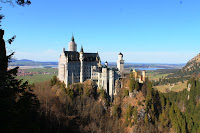
Fairy tale castle by the Fairy Tale King.
essentially two hours of beautiful German countryside. The castle itself is famous worldwide, and was the inspiration for the Sleeping Beauty castle in Disneyland. It was built by Ludwig II (or rather, it was built by his money) starting in 1869 with the "latest technology" of the time (for example, running water throughout the castle, central heating, etc.), but the intention was that the castle look medieval in style. "Neuschwanstein" literally translates to "New Swan Stone Castle" and reflects Ludwig's obsession with swans (he was nicknamed the "Swan King," among other things) The castle was built as a "retreat" or "escape into a dream world" for Ludwig, with much of the interior design inspired by the operas of Wagner (to whom he apparently even dedicated the palace). In 1886, Ludwig died mysteriously and in a lot of debt. Much of the castle (such as the entire second floor) was never completed to this day (it now houses the gift shop and cafeteria). The throne room, one of the most ornate rooms of the castle, contains no throne
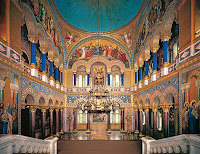
Throne Hall, sans thrones.*
Singers' Hall.*
because it too remained unfinished at the time of Ludwig's death. Ludwig never intended for the castle to be opened to the public, but in order to balance out the construction debts, it was opened to the public for a fee only six weeks after his death. Aside from the throne hall, one of the most important rooms of the castle is the Singers' Hall, whose walls have various scenes from Wagner's operas and scenes of medieval knights and legends, with whom Ludwig apparently "identified." Anyway, enough about the history of the castle. All you need to know is that it's very cool and definitely worth a visit if you're in southeastern Bavaria. (For those interested, this website gives a bit of information and photos of the rooms you would see on the guided tour.)

Right near Neuschwanstein is another smaller and somewhat less impressive castle called Hohenschwangau, which was where Ludwig II grew up. It was built as the summer residence of the royal family by his father, King Maximilian II of Bavaria. The castle is still privately owned but you can visit it with a guided tour. In the little town where the two castles are located (also called Hohenschwangau), there are two really pretty lakes from which you can see the mountains bordering Austria off in the distance. Unfortunately, the town is mostly full of tourists, but somehow it manages to keep its beauty and even a big of peacefulness (mainly by the lake), in my opinion.
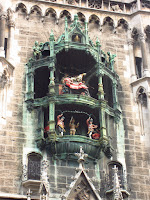
Glockenspiel
So after spending most of the day in Castlelandia, Nicole and I decided to visit the Olympic park that was home to the 1972 Olympics. On day two, we spent the morning wandering around the old town, including the Marienplatz, home of the famous carillon in the tower of the town hall, the famous marketplace, and St. Peter's Church. The Marienplatz is really cool and I personally don't think the glockenspiel (carillon) show is underrated. I was going to put a video clip of the glockenspiel, but my video files sadly seem to have stopped working for me, so a picture will have to do. The market, Viktualienmarkt, is also awesome; there were tons of fresh fruits and vegetables, German crafts, and the beginning of many, many, decorated Easter
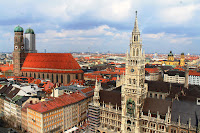
View from Peterskirche.
eggs. Then we went up in the tower of Peterskirche, which has some great views of the Marienplatz, the market, and the rest of the city. After all this, we went to the famous Hofbrauhaus for lunch. The place is HUGE, but nicer than I'd expected. Not just your average beer hall. The place is actually pretty nice on the inside, with the ceilings and walls decorated, live music, and, well, beer. As for German cuisine, it's
not horribly different from Spanish cuisine in terms of ingredients: lots
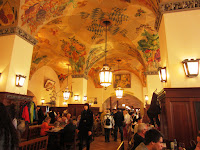
Inside the Hofbrauhaus.
of pork, sausage, and potatoes. However, the Germans seem to do it differently. I don't dislike Spanish food, but I'm so tired of it, so German pork and potatoes were a nice change. (Not to mention they know how to make beer. The Spanish, sadly, do not.) After lunch, Nicole and I visited the Schloss Nymphenburg, a 17th century baroque palace that was the summer residence of the Bavarian ruling family for a couple of centuries. The place has pretty extensive gardens and SO MANY swans. Totally worth a visit.

Day three was dedicated to Dachau. Dachau was one of the first (or maybe THE first, not positive) concentration camps, first opened as a camp for political prisoners only a few weeks (on March 22nd, 1933) after Hitler was appointed Reich Chancellor. The camp was used as a model for other concentration camps, and as it was one of the earliest, the name "Dachau" was feared throughout the region. Starting in 1937, mass arrests began and these people were sent to Dachau (along with other camps). They entered the camp through a gate that is still there, reading "Work liberates." Over the course of its 12-year use by the Third Reich, over 200,000 people from over thirty countries were taken prisoner at Dachau. Even though Dachau was a work camp, not an extermination camp, 41,500 people were murdered there from extreme forced labor, malnutrition, typhus outbreaks, etc. There were two crematoriums (a small one and a bigger one built with greater capacity), but there are no records that they were used for mass cremations. Dachau was liberated in 1945 by US troops. Later on, in 1965, the Bavarian State opened up the Dachau Memorial Site, which is of course, still there today. Some of the original buildings remain, while others (like the barracks where the prisoners "lived") are reconstructions. There are also religious structures that have been built for visitors, as well as memorial statues and monuments, some more explicit than others but all equally emotionally provocative.
"Never Again" memorial with ashes of unknown prisoners in front.
Anyway, in terms of our visit to Dachau, it was obviously not the most fun part of our trip, but definitely worth it. We took a three-hour guided tour of the camp, although you can do a self-guided tour; there's still plenty of information that will take you hours to get through. I don't think there's ever any way to fully grasp the horrors of the concentration camps and all of the things that went on leading up to and during the Holocaust, but visiting the concentration camp memorial sites is one way to move towards an understanding of not why or how these things occurred, but at least what occurred.

After our cheerful morning at Dachau, we spent the afternoon in the English Garden, one of the world's largest municipal parks (it's even bigger than Central Park!). This wrapped up our time in Munich and Germany - that night we left for Salzburg, Austria.


*Photos taken from the Neuschwanstein Castle website: http://www.neuschwanstein.de/englisch/palace/index.htm