This is going to be a long one. Munich. Capital of Bavaria. Everything one could ever want in the name of German food, German beer, Germany castles...Maybe I'm romanticizing it all. I've seen so little of Germany that it's not fair to say that Bavaria (or Munich, for that matter) is any better than the rest. But it is so very, very wonderful.
We spent three days in Munich. Split up into one day visiting Neuschwanstein (the famous castle that you're sure to recognize), one day visiting Munich the city itself, and one day visiting Dachau, the memorial site on the grounds of what was one of the earliest concentration camps. So, let me first tell you what I know about Munich. As I said, it's the capital of Bavaria, one of the southern states of Germany. It's the third largest city in the country. It was the sight of the 1972 Summer Olympics where Mark Spitz won what was at the time a record seven gold medals. It's home to the BMW headquarters. Beer isn't an alcoholic beverage, it's just another part of the culture (Oktoberfest, anyone?). It houses one of the biggest and most famous beer halls, the Hofbrauhaus. The carillon (glockenspiel) on the tower of the town hall has puppets that sing and dance a few times a day. Enough to whet your appetite?
So, as previously stated, day one in Munich was dedicated mostly to Neuschwanstein. Amelie decided she didn't want to make the trek there, so Nicole and I took the two-hour train in the morning out to the little town where the famous castle is located. I should add that the train ride itself is really nice, since it's
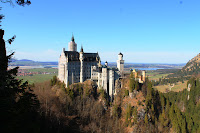 |
| Fairy tale castle by the Fairy Tale King. |
essentially two hours of beautiful German countryside. The castle itself is famous worldwide, and was the inspiration for the Sleeping Beauty castle in Disneyland. It was built by Ludwig II (or rather, it was built by his money) starting in 1869 with the "latest technology" of the time (for example, running water throughout the castle, central heating, etc.), but the intention was that the castle look medieval in style. "Neuschwanstein" literally translates to "New Swan Stone Castle" and reflects Ludwig's obsession with swans (he was nicknamed the "Swan King," among other things) The castle was built as a "retreat" or "escape into a dream world" for Ludwig, with much of the interior design inspired by the operas of Wagner (to whom he apparently even dedicated the palace). In 1886, Ludwig died mysteriously and in a lot of debt. Much of the castle (such as the entire second floor) was never completed to this day (it now houses the gift shop and cafeteria). The throne room, one of the most ornate rooms of the castle, contains no throne
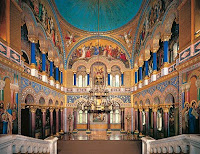 |
| Throne Hall, sans thrones.* |
 |
| Singers' Hall.* |
because it too remained unfinished at the time of Ludwig's death. Ludwig never intended for the castle to be opened to the public, but in order to balance out the construction debts, it was opened to the public for a fee only six weeks after his death. Aside from the throne hall, one of the most important rooms of the castle is the Singers' Hall, whose walls have various scenes from Wagner's operas and scenes of medieval knights and legends, with whom Ludwig apparently "identified." Anyway, enough about the history of the castle. All you need to know is that it's very cool and definitely worth a visit if you're in southeastern Bavaria. (For those interested,
this website gives a bit of information and photos of the rooms you would see on the guided tour.)
Right near Neuschwanstein is another smaller and somewhat less impressive castle called Hohenschwangau, which was where Ludwig II grew up. It was built as the summer residence of the royal family by his father, King Maximilian II of Bavaria. The castle is still privately owned but you can visit it with a guided tour. In the little town where the two castles are located (also called Hohenschwangau), there are two really pretty lakes from which you can see the mountains bordering Austria off in the distance. Unfortunately, the town is mostly full of tourists, but somehow it manages to keep its beauty and even a big of peacefulness (mainly by the lake), in my opinion.
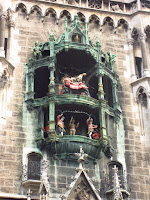 |
| Glockenspiel |
So after spending most of the day in Castlelandia, Nicole and I decided to visit the Olympic park that was home to the 1972 Olympics. On day two, we spent the morning wandering around the old town, including the Marienplatz, home of the famous carillon in the tower of the town hall, the famous marketplace, and St. Peter's Church. The Marienplatz is really cool and I personally don't think the glockenspiel (carillon) show is underrated. I was going to put a video clip of the glockenspiel, but my video files sadly seem to have stopped working for me, so a picture will have to do. The market, Viktualienmarkt, is also awesome; there were tons of fresh fruits and vegetables, German crafts, and the beginning of many, many, decorated Easter
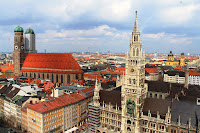 |
| View from Peterskirche.
|
eggs. Then we went up in the tower of Peterskirche, which has some great views of the Marienplatz, the market, and the rest of the city. After all this, we went to the famous Hofbrauhaus for lunch. The place is HUGE, but nicer than I'd expected. Not just your average beer hall. The place is actually pretty nice on the inside, with the ceilings and walls decorated, live music, and, well, beer. As for German cuisine, it's
not horribly different from Spanish cuisine in terms of ingredients: lots
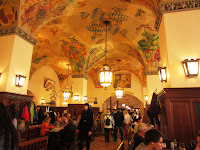 |
| Inside the Hofbrauhaus. |
of pork, sausage, and potatoes. However, the Germans seem to do it differently. I don't dislike Spanish food, but I'm so tired of it, so German pork and potatoes were a nice change. (Not to mention they know how to make
beer. The Spanish, sadly, do not.) After lunch, Nicole and I visited the Schloss Nymphenburg, a 17th century baroque palace
that was the summer residence of the Bavarian ruling family for a couple of centuries. The place has pretty extensive gardens and SO MANY swans. Totally worth a visit.
Day three was dedicated to Dachau. Dachau was one of the first (or maybe THE
first, not positive) concentration camps, first opened as a camp for political prisoners only a few weeks (on March 22nd, 1933) after Hitler was appointed Reich Chancellor. The camp was used as a model for other concentration camps, and as it was one of the earliest, the name "Dachau" was feared throughout the region. Starting in 1937, mass arrests began and these people were sent to Dachau (along with other camps). They entered the camp through a gate that is still there, reading "Work liberates." Over the course of its 12-year use by the Third Reich, over 200,000 people from over thirty countries were taken prisoner at Dachau. Even though Dachau was a work camp, not an extermination camp, 41,500 people were murdered there from extreme forced labor, malnutrition, typhus outbreaks, etc. There were two crematoriums (a small one and a bigger one built with greater capacity), but there are no records that they were used for mass cremations. Dachau was liberated in 1945 by US troops. Later on, in 1965, the Bavarian State opened up the Dachau Memorial Site, which is of course, still there today. Some of the original buildings remain, while others (like the barracks where the prisoners "lived") are reconstructions. There are also religious structures that have been built for visitors, as well as memorial statues and monuments, some more explicit than others but all equally emotionally provocative.
 |
| "Never Again" memorial with ashes of unknown prisoners in front. |
Anyway, in terms of our visit to Dachau, it was obviously not the most fun part of our trip, but definitely worth it. We took a three-hour guided tour of the camp, although you can do a
self-guided tour; there's still plenty of information that will take you
hours to get through. I don't think there's ever any way to fully grasp the horrors of the concentration camps and all of the things that went on leading up to and during the Holocaust, but visiting the concentration camp memorial sites is one way to move towards an understanding of not
why or
how these things occurred, but at least
what occurred.
After our cheerful morning at Dachau, we spent the afternoon in the English Garden, one of the world's largest municipal parks (it's even bigger than Central Park!). This wrapped up our time in Munich and Germany - that night we left for Salzburg, Austria.
*Photos taken from the Neuschwanstein Castle website: http://www.neuschwanstein.de/englisch/palace/index.htm


