lunes, 14 de marzo de 2016

My 5 Favorite Day Trips from Madrid

There are, of course, the obvious day trips. Toledo, Segovia, San Lorenzo de El Escorial, Avila, Salamanca. All great places with beautiful architecture, winding narrow streets, and great places to eat. But there are other, less well-known places that are certainly worth visiting.

Chinchón

With its beautiful and unique circular plaza mayor, Chinchón is a great place to walk around and explore on foot. Worth visiting is Cuevas del Murciélago, where you can both eat and visit the wine cellars and sample wine. The town is also well-known for its anis and garlic - they have festivals for both in the fall! Not too far away is also Colmenar de Oreja, which also has a charming plaza mayor.

Aranjuez

Aranjuez has many tourist attractions such as the royal palace, one of the earliest bull rings with its museum, an several churches, I love it for the gardens. The palace has extensive, beautiful gardens where you could easily spend hours walking around exploring the many fountains, buildings, and plants. A great way to visit Aranjuez is to take the Tren de la Fresa (Strawberry Train), which includes a round-trip trip in a historical train (!!), and two "plans" once you arrive in Aranjuez: either a guided tour of the palace or of the gardens, along with a few other museums. And, true to its name, you're given fresh strawberries onboard the train.

Rascafria

El Paular & Puente de Perdon
Tucked away up in the Sierra of Madrid, Rascafría is a great place to go in the summer (though it's definitely not an undiscovered place for locals!). Skip the town itself - there's nothing interesting there - and go to the location of Monasterio de El Paular. The area is a charming little place between the Monastery and the Puente del Perdón, an 18th-century bridge. The river that flows by is also a great place to take a dip - the fresh mountain water is always nice and cold!


El Atazar Reservoir
Patones de Arriba

Patones de Arriba (note - you have to walk up here from Patones de Abajo) is a well-preserved ancient little village full of black slate houses. It's so small you can easily walk around in a short time, but you'll want to stay longer because it has such a rugged uniqueness to it. Check out local artisan products like honey, cheese, and chocolate truffles. Also worth a short car ride away is the lookout point of the El Atazar reservoir, where you'll get absolutely stunning views of a landscape void of any building.

Patones

Consuegra

You know how Don Quijote thought he was fighting giants, but they turned out to be windmills? This is the perfect place to see classic molinos of La Mancha. Consuegra is well-known for its saffron, and they have a festival celebrating it in the fall.
Consuegra


Let's face it: I could probably go on and on with great places to visit, but these are my favorites!

martes, 15 de diciembre de 2015

My Favorite Unusual or Unique Museums around the World

I am by no means a museum expert. And while I do enjoy the occasional museum, I tend to find them to be daunting tourist attractions that I feel obligated to visit because of their cultural and/or historical importance. I especially dislike art museums - I recognize they are important cultural institutions, but I personally just find most art museums to be tiring and boring. The more I travel, the more I've begun to bypass these places while traveling, no matter how important or famous they may be.

However, there are some museums that I have visited in my travels that are FANTASTIC and should not be missed by any tourist. Of course this list is very limited, but I think it does offer variety and uniqueness.

1. Miniatur Wunderland - Hamburg, Germany

This museum may be best for children. Or nerdy adult train obsessives. I am the latter. I love trains. Train rides, historic trains, miniature train models. You name it. So this museum was incredibly fun for me (and Emilio liked it a lot too). Basically it's full of room after room of extremely elaborate dioramas of all different types - models of real cities, mountain scenes, and probably the most awesome one, a model of Hamburg's airport, complete with model planes taking off and landing (no, planes are not trains...but this was fabulous nonetheless). So. Awesome.

2. Haus der Musik - Vienna, Austria

I've been to this museum twice now because even though I really dislike Vienna (sorry, Vienna), I adore this interactive museum. It's a pretty massive building with several floors, each with a different theme, including one dedicated to the famous Vienna Philharmonic (with a video of the latest New Year's concert), one explaining the science behind tone and sound, and one dedicated to Austrian composers. The best exhibits are the most interactive ones - you can roll dice to compose your own waltz and you can conduct your own orchestra!

3. Teatro-Museo Dalí - Figueres, Spain

I've mentioned many times that I'm not a huge fan of art, but I do love Dalí. The Costa Brava, up in the northeast corner of Spain, is a great place to discover more about Dalí's life and inspiration. This museum is fascinating. I especially liked how it's not a lot of paintings, but rather sculptures, statues and objects. The building itself is pretty wacky with statues and giant eggs all around the roof. He was one crazy dude, that's for sure.


4. Tinguely Museum - Basel, Switzerland
One of the bigger exhibits - EVERYTHING moves!


This is another museum that I've been to twice because the second time I was in Basel with Emilio I had to take him. Jean Tinguely was Swiss artist who is best known for "metamechanics," or basically sculpture machines. The museum tells you about Tinguely himself, but the best part are the original sculptures, which when you press a button, literally come to life. They start moving, making noise, playing music, creating things, you name it. So, so worth a visit if you're in the area (or even if you're not - Basel is a beautiful city!).

5. Museo Art Nouveau y Art Déco Casa Lis - Salamanca, Spain

I never realized that I actually like Art Nouveau until I discovered this museum in a beautiful building perched on the hill of old town Salamanca several years ago. The building has lots of colorful stained glass and is full of Art Nouveau/Art Deco style figurines, jewelry, statues, and other objects. It's not too big so it's not overwhelming, which I always appreciate in a museum.


6. House of Terror, Budapest

This museum is a very interesting an relatively interactive museum about communism and fascism in 20th century Hungary. It's also intended to be a memorial to victims of these time periods. Hungary, like many other countries in central and eastern Europe, was severely affected by Nazi and Soviet influence, and the Hungarian communist regime lasted decades. The House of Terror, located in what was the headquarters of the Hungarian communist party, exhibits all of this in an interesting way. I really learned a lot but wasn't at all bored here. I think it's also important to have a general understanding of modern Hungar
ian history if you happen to already be visiting.

7. Sorolla Museum - Madrid, Spain

Yup, this is an art museum. But as the museum is located in Joaquín Sorolla's own beautiful mansion of a house, the building itself is an important part of the museum. This is a great place to see a bit of Spanish art without getting overwhelmed. While the Prado, Reina Sofía, and Thyssen museums are very very good, they are huge and at least I get overwhelmed visiting them. But the Sorolla Museum is small, the house is lovely, and the gardens, designed to imitate Andalusian mudéjar art and it makes you feel like you're in a mini-Alhambra or Alcázar garden.

8. Hotel Viru KGB Museum - Tallinn, Estonia

The last museum is, yes, part of a hotel. I absolutely love Tallinn - it's such an underrated and stunningly beautiful city. This is another museum that I've visited twice because I brought Emilio there the second time. Basically, Estonia was one of the Soviet states until the collapse of the USSR. The Viru Hotel opened in 1972 and the last floor was a particularly important KGB radio center. As the hotel at the time was designed for important, rich foreigners, the KGB operated here by bugging rooms to spy, as the KGB was meant to do. A few years after the collapse of the Soviet Union, with the KGB long gone, the secret rooms and devices - literally just dropped and left behind - were discovered and converted into a museum. It's also a reminder that Russia remains a mere 150 miles (or less) away.

Of course there are other unusual or unique museums that I've enjoyed in Spain and around the world, but these are some of my favorites and I would definitely recommend them.

jueves, 6 de agosto de 2015

#22 See the Sunset from the Templo de Debod

While the Templo de Debod has always been infamous for the botellón (drinking in the street) that is always going on there, it's also famous for the beautiful sunsets that you can witness there.


This more than 2000-year-old temple was donated to Spain from Egypt in the 1960s. It's really quite impressive, inside and out. During the day you can visit the inside of the Egyptian temple, and though it's quite a small and tight space inside, you can see lots of hieroglyphs, images, and statues. Since entrance is free, it's worth a quick look inside! And, of course, don't forget to go back at sunset on a clear day.

martes, 5 de mayo de 2015

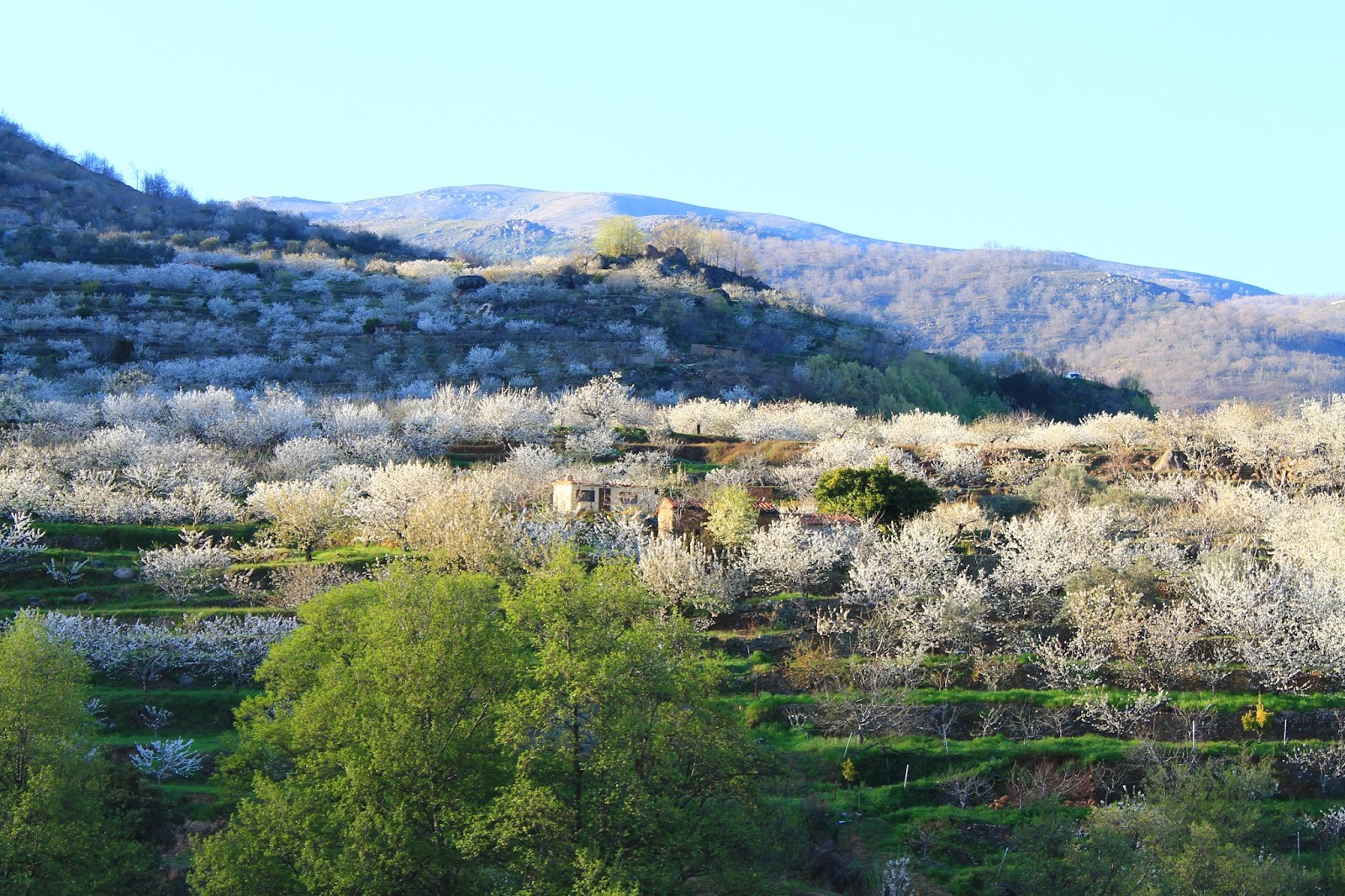
Valle del Jerte - Cherry Blossoms Galore

One thing I love about Spain is its various blossoming fruit trees. The most common are the almond trees whose flowers bloom in February and can be white or really pretty pink colors, and the cherry trees that bloom sometime in March or April, depending on the weather and region.

Now, of course Spain isn't the only place with lots of cherry trees that blossom in the spring, but I still think that Valle del Jerte is a special, special place. For about ten days in the spring each year, kilometers and kilometers of land covered with cherry trees turn white as the flowers bloom. Cherry blossom festivals started in the region 70 years ago and as a result, it's a historic heritage site of Spain. The blossoms alone (because there is literally nothing else in this relatively remote area of the country) bring plenty of tourists during these lone ten or so days each year - and for good reason; it's stunning!


sábado, 4 de abril de 2015

#67 See Goya’s frescoes in the San Antonio de la Florida Chapel

Frescos of the chapel.
I truly know next to nothing about art. I can name you some famous artists (mostly painters) and I can give you a short list of important Spanish artists, but that's really it. Honestly, I'm just not much of a fan of art. Especially portraits and religious paintings. I really find nothing more boring than walking through the Prado passing portrait after portrait of whatever king or queen or duke or whatever of Spain; then painting after painting of Jesus, Mary, or any of the other gazillion saints.

However, there is some art that I do like, and even the art that I don't like I can at least recognize its significance. (Except abstract expressionism - I'm sorry but I simply do not understand this type of painting - I don't care how much  you tell me about dripping paint, or layers of paint, or brushstrokes, or the special meaning behind the color red, it's not art!) Francisco de Goya is one of such painters - the boring portrait type that I dislike but recognize his importance, that is. He often painted people (though certainly not exclusively), including the Spanish royal family, for whom he worked. He died in Bordeaux, France in 1828, but nearly a century later in 1919 his remains were transferred to Madrid and reburied in the Ermita de San Antonio de Florida.
Frescos on the domes.
The chapel was originally built for the saint after whom it is named. What I do like about Goya are the Neoclassical frescoes that he himself painted in just six months on the chapel's ceilings. They mainly (in a nutshell) depict scenes from Saint Anthony's life, as well as images from 18th century Madrid. I personally don't understand the technique or significance behind the frescoes, but they are quite beautiful. Plus, I think there's extra merit to painting a fresco - it can't be an easy or pleasant task to paint a gigantic image standing on a ladder of some sort, craning your neck, half upside-down in order to get that stuff on the ceiling.

miércoles, 19 de noviembre de 2014

#33 Visit Valle de los Caídos

If you've ever traveled in Spain, north of Madrid, you've most likely seen an enormous cross off in the distance in the mountains. It's virtually impossible to miss. After all, that was the purpose of its location (in the Guadarrama mountain range, over 900 meters above sea level) and size (150 meters tall) - it can be seen from over twenty miles away. Seeing as Madrid has an average of over 300 days with sunshine each year, many of which include cloudless skies, that massive cross is in the perfect position for optimal viewing, whether the people of Spain like it or not.
View from only a few miles away during my hike up to it.
This cross belongs to a 3360-acre complex called - if you hadn't already guessed - Valle de los Caídos, which translates to Valley of the Fallen. I could probably go on and on about the place - its history, its purpose, its significance, its position as perhaps the most controversial monument in Spain, etc., but I'll try to give you an abridged version (explained to the best of my knowledge)...ha ha...if that's possible. But anyway, it's because of the last reason I listed - the controversy over the monument, that I think I find it so interesting.

If you didn't already know, Spain, not unlike much of the rest of 20th century Europe, went through a period in which it was under the rule of a dictator. This period, known as Francoism, began in 1939, when General Francisco Franco's regime won the Spanish Civil War, and ended in 1975, when he died. Unlike many other dictators of 20th century Europe, Franco was anti-communist (which led the US to ally with Spain during the Cold War, but that's a tangent I'm not going to get into). Instead he supported a fascist political movement called the Falange Española de las Juntas de Ofensiva Nacional Sindicalista, and as a result, Spain suffered religious, cultural, and political oppression for nearly forty years.
Cross and basilica. The monastery is on the other side of the hill.
During his time in power, Franco decided to create a memorial to all of the Spaniards who died during the Spanish Civil War in the 1930s. Official records state that 33,700 people are buried there. Franco also ordered that José Antonio Primo de Rivera, the founder of the Falange political movement, be buried in the basilica built under the cross. The tomb of Franco himself is also in the basilica, although this was not his wish. For this reason, among many others (including the facts that the monument commemorates those who helped support and fight for Franco's political cause and also that political prisoners were used to build the monument in an exchange for reducing their sentences), Valley of the Fallen has always been a point of contention in Spain. I've met plenty of Spaniards who haven't ever visited the monument and some who say they never will because of what it stands for.

Ceiling of the basilica, right under the cross.
Franco's tomb. Many want to relocate it.
In 2009, the government led by then Prime Minister Zapatero closed down the basilica at Valley of the Fallen, saying that many of the statues, including the one below, La Piedad (Catholicism was the only religion tolerated under Francoism), was in serious need of restoration and was therefore a safety concern. This angered many people, some who still support the things for which Franco's government stood, some who consider the monument to be of cultural importance, etc. I find particularly interesting that one particular group called the government "Talibanes socialistas," comparing the situation to the destruction of the Buddhas of Bamiyan, because supposedly the removal of the sculpture was destroying its integrity. (I'm not convinced of the correlation.)
"La Piedad."
Anyway, when I arrived in Spain in the summer of 2010, I was a bit disappointed to realize that I couldn't visit Valley of the Fallen. Regardless of the significance behind the monument, I think it's an important part of Spanish history. (I have similar feelings about Nazi concentration camps - they reflect a terrible period in what is still very recent history, but they should be preserved as a reminder of things that should never happen again.) For this reason, when I originally posted my list of 101 Things to Do in Madrid, I wrote that "this one probably won’t happen because it’s been closed since November of 2009 with no reopening in the foreseeable future." However, it was reopened in November of 2011, following Rajoy's election as Prime Minister.

So I decided to spend this past Saturday in the sierra. The only public transport from Madrid takes you to the entrance of the complex, which is at the bottom of a hill 3.5 miles from the actual cross, basilica, and monastery. I think I spent more time walking up and down that road than I did actually at the monument. (Later I discovered if you travel to El Escorial first, there is a bus that takes you all the way to the monument, but it only makes one trip there and back each day. Still, worth it if you're not in the mood for a hike.)
Hall leading to Franco's tomb. There are no windows in the basilica.

Beautiful scenery as you walk out of the basilica.
Anyway, the place is a unique and bizarre mixture of mega creepy/disturbing and serene beauty. The mountains, the scenery, the views from up there - are beautiful. The dark, windowless tunnel in the giant tomb-basilica and the gigantic cross - are, for lack of a better word, creepy. While I'm not sure that I would say that I like the place, I do still find it fascinating (the most interesting things are the things that are most controversial, after all, right?) and worth a visit.

miércoles, 11 de junio de 2014

Flamenco in Madrid

I'm not the world's biggest flamenco fan, but it's definitely something worth seeing as a tourist (if you go to the right place), and something that's shameful not to see at least once if you're living here.

The best flamenco is typically in Andalucía, where it originated most likely with lots of influence from the Roma (gypsy) people living there. It's a mixture of dance, singing, guitar, and hand clapping. I like the dance element the most (the singing is a little...whiny).

Villa Rosa
In Madrid there are plenty of places to see flamenco, and I've been to three. The first was at Casa Patas near Antón Martín, which I enjoyed but I thought was a little pricey. Currently the price for entrance to the show with a drink included is 38€. The place has a restaurant as well, but the room where the show is performed is pretty small, giving you a good view of the performers.

The second place, and probably my favorite, was at Villa Rosa in the Plaza Santa Ana. It actually is currently around 35€ for the show with a drink, but somehow when a friend and I went, we managed to get a high table towards the back at the price of only what we ordered (this may be a big reason why I liked it the most!). We had great views and a great time!

Villa Rosa

The last place I also enjoyed a lot was at La Quimera, located near the bull fighting stadium. The prices vary depending on if you want to see the show with a drink, with dinner, and most importantly, if you book in advance (it's a lot cheaper). I went with a small group of friends and we had dinner while we watched the show. The food was good and the show was great, as the place is pretty small and we had great views.

There are so many other places to see flamenco here, so it's never a bad idea to do a little research and check out other places as well. But I can vouch that these three places, particular Villa Rosa and La Quimera, are worth the visit.

miércoles, 21 de mayo de 2014

#74 Discover the history of the Metro at Andén Cero (Platform Zero)

Sooo I really like abandoned places and antique things. I don't exactly go so far as to break into abandoned places in order to explore them, but I definitely will hit up a museum or exhibit related to either topic. The Andén Cero is a small exhibit located in the former Chamberí metro station. (And actually they have a second little museum consisting of an "engine shed" in another part of the city that I haven't yet visited.)


Chamberí station was one of the original eight stations of the first metro line built in Madrid in 1919. The station was closed a few decades later in the 60's when the city began extending the metro lines. It was reopened as a bit of a blast-to-the-past exhibit, complete with old posters advertisement on the walls and original tiling. The place is small, but since it's free to see it's a neat little place to visit.

jueves, 20 de febrero de 2014

#72 See Madrid from Cerro de los Ángeles (666 meters in altitude)

Cerro de los Angeles (literally "Hill of the Angels") is a little hill a several kilometers south of Madrid. It's sort of in the middle of nowhere and is really only famous for one reason: it's considered the geographic center of the Iberian Peninsula (which is composed of Spain and Portugal). It also has a small 14th century monastery and a large monument with statues of religious figures, including a pretty large one of Jesus (sort of Rio-Christ-the-Redeemer-style), on top. Although not a hugely fascinating place, it is a pretty little hill with parks and good views of Madrid.


The hill is supposedly at an elevation of 666 meters above sea level, but I've read in different places that it's actually 670 meters, or some other number in the 660s, which, really, is better, because I wouldn't even know how to analyze Spain's building a nice big religious monument named "Hill of the Angels" at Satan's earthly altitude. Although - I suppose Satan is the fallen angel, so technically the name isn't inaccurate?

viernes, 13 de diciembre de 2013

#45 Enjoy the Madrid skyline from the cable cars

One of my favorite things to do in Madrid is ride the teleférico, or cable cars in the Casa de Campo park. I especially like to take the cable cars from the entrance in the Argüelles neighborhood at the edge of the park, and then once I get to the other end in Casa de Campo, walk through the park until I get to the lago (lake) where there is a metro stop (or on occasion I continue into the city on foot from there). The park is a great place to walk around (during the day! don't go at night).
View of the palace, cathedral, and Principe Pio station


Sierra de Madrid

The cable cars give you great views on one side of the mountains up north of Madrid, and on the other side, of the royal palace, cathedral, and really all of the western edge of the city. It's definitely a great place to go on a day with good weather.